Showing posts with label Tate Britain. Show all posts

Saturday, 30 March 2019

Stripped but not bare


“I felt that these galleries should somehow be returned to what they once had been, halls for monumental sculpture. Places where people could come and wonder at the sheer physicality of sculptural objects.” - Mike Nelson
 

Nothing in Mike Nelson’s [1967- ] latest installation ‘The Asset Strippers’, located in the vast, stone-carved walls of Tate Britain’s Duveen Galleries is trying to be art. It simply just is. Former industrial-sized knitting machines, a digger bucket, a cement mixer, scales, a lathe and a hay-turner are amongst a series of abandoned machines from salvage yards and online auctions of company liquidators, which have been collected and presented at the Tate as sculptural objects. Woodwork benches complete with vices, drawers and remnants of string and detergent bottles become the plinths on which many of these ‘ready-mades’ reside.

Each piece of machinery is a remnant fallen into neglect and disuse, symptomatic of the shift in ways of manufacture and decrease from manual industries to service ones. I confess that I don’t recognise what the majority of the machines here were even for! I am probably not alone in this acknowledging that there is also something unexpectedly exciting about trying to imagine or ‘work-out’ what the purpose of these things once was (or perhaps could be!). Like Francis Picabia’s paintings of imaginary Surrealist/Dada-esque machines, there is also the slightly more obvious connection to Duchamp’s ‘The Bride Stripped Bare by her Batchelors, Even’ in the way these mechanical parts have been arranged as though for a new use (for which they had previously not been intended) and collaged together. In one piece telegraph poles lay horizontally atop red, blue and yellow tarpaulin on which supports a circular tube (from possibly a drain) of sorts; balanced together in a sort-of ‘found-objects’ version of an Anthony Caro sculpture which can be seen also in the Tate Britain only a few rooms away. Nearby a former hay-turner is presented so that its’ turning blades take on the appearance of four golden suns or flowers; an association that I feel, relates to the dry sunny days during which the hay-turner would have been put to use. My mother commented that this machine reminded her of the one her parents used on the farm in Somerset and that she had never before looked upon or seen it in this way (as sculpture).
 
Formally and aesthetically speaking there is much to be gleaned from looking at all of this. Graffitied, worn and stained surfaces, flaking paint; artificial metallic blues and bright reds against natural woody browns and oil-stained metals. Boxy squares, circles, stacks and lines from threads and strings still connected in the knitting machines all make for a rich list of sculptural criteria. Though the question of whether we are being asked to appreciate these machines as sculptural objects or to look upon them as relics from the past (or both) is really where this piece becomes both socially significant as well as aesthetic. The knitting machines are reminiscent of the ones Nelson’s family worked on whilst growing up in the East Midlands, now in his early fifties, Nelson and many of his generation and before will have seen a broader picture, perhaps than myself, in just how much Britain has significantly changed from the industrial era to more service-based ones. Doors from a NHS hospital and wood from a former army barracks act as visual and functional barriers to divide and section the individual components of this installation into curated parts of one bigger, immersive piece; they also unintentionally or not comment on the value of both art and the materials it uses and the value or shift in value we have as a society towards institutions like the NHS and manual industries generally. For me, these make-shift walls help contain the unmistakable smell of oil from all of the machinery that is reminiscent of my grandfather’s workshop on the farm. I am utterly bias in this whole post from projects I have previously done on car engines and farming tools!

In a previous work, titled ‘Coral Reef’, seen at the Tate in 2000 Nelson similarly used reclaimed materials to create a movie-set-like-labyrinth of rooms. Each sparsely lit by naked-bulbs and grubby reclaimed timber to create a slightly seedy or sinister spaces, a gallery reception area, a taxi-office, a heroin-den; each with a story awaiting to happen, they are suspenseful and the closet experience I have ever come to like being inside an Edward Hopper painting; their commonality being the absence of people. There is something similarly haunting about ‘The Asset Strippers’ and as the name suggests it is after the factory has closed, the people who once knew the purpose of these great beast-like contraptions have since left along with their stories and their skills to work these machines. All is quiet. All is now still. It seems that in stripping these places into their bare commodities we have also stripped or lost something of the people, stories and time in which they previously existed. It is a proverbial ghost-ship but in being reclaimed as sculpture, as ‘art’ and displayed in the Duveen Galleries of Tate Britain where historically ‘treasures of the empire’ were seen, they are memorials to this past heritage whose concept of  ‘value’ is in-turn put into question. What once were stripped assets are now reassembled art. 
 
Mike Nelson –The Asset Strippers at Tate Britain until October 6th 2019
 

Friday, 7 November 2014

Turner Prize in your eyes!

There is a lot of carpet flooring in this year’s Turner Prize which could also be something to do with three of the four selected artists being film based [carpet, of course dampening the distracting sound of footsteps]. It took me longer than I’d probably like to admit to arrive at that conclusion spending my first Turner Prize 2014 moments adjusting to the dark, sound proofed interior of the exhibition space at Tate Britain. The 2014 prize marking my third overall Turner Prize viewed, the first artist/work of which I’m confronted by in the year's show was James Richards's film, ‘Rosebud’ displayed on what is possibly the biggest free standing television monitor I’ve ever seen! I sit down next to my fellow Turner Prize goers, a middle-aged woman (or so I assume!) and a young mum and toddler, wondering if they are full of the same heightened sense of expectation and intrigue as me. A minute later and the middle-aged woman begins administering herself eye-drops, much to my bemusement, a darkened art gallery being a fairly impractical place to start dispensing eye-care, surely? But needs must and I speculated if maybe there was something in her eye medicine that made her see everything a little differently or maybe she was preparing or purifying her eyes in anticipation for what she was about to see...? Perhaps I should have asked to borrow some? Should eye-baths be dispensed at the beginning of all art exhibitions? Sadly, though I did not know it at the time, this amusing encounter was to be one of the few lasting images I took away from this year’s prize. 

Sigh.
 
Now in its 31st year the 2014 Turner Prize features the work of four artists, ‘under the age of fifty, born, living or working in Britain, for an outstanding exhibition or other presentation of their work in the twelve months before April 2014’.  This year’s nominees include; Duncan Campbell, Ciara Phillips, James Richards and Tris Vonna-Michell. On Monday 1st December one of these four artists will be chosen to win the £25,000 prize by a ‘jury’ of art curators from this country and abroad. Locals may note one of them being the Director of Bristol’s ‘Spike Island’, Helen Legg.

Rather depressingly this year’s Turner Prize is dominated by film. And ironically, after an earlier post about my inhibitions to watching film in art galleries generally*, I now found myself in a situation where I have to watch three all at once! Debatably previous Turner Prize’s may have been too accommodating, or trying to be inclusive for short-listing artists across different mediums each year (painting, sculpture, film and in more recent years performance art being represented) but I find it somewhat sad that there isn’t at least one painter, sculptor amongst the group and don’t feel the decision of so many film artists nominated this year is reflective of a decline in the quality or abundance of artists who categorise themselves as painters, sculptors etc. In fact, the Turner Prize felt like something of an anticlimax after having to navigate one’s way through the breathtaking scale of the Phyllida Barlow's installation of ‘stuff’ in the Duveen Galleries. Surely she deserves to be nominated one year?

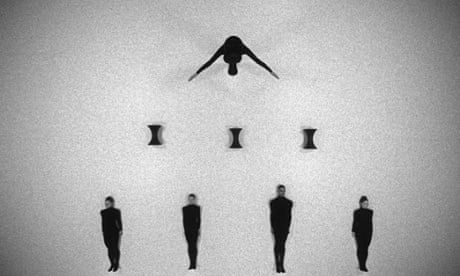
Still, the Turner Prize has always been renowned for its notoriety, its controversy and its general challenging, at times awkward relationship with both the public, the media and the art world alike. In defence of this year’s chosen four, when you go into the work in more detail, one begins to realise it is perhaps the labelling of ‘film art’ that becomes irrelevant and blurred as each artist uses the medium differently. Stills from Duncan Campbell’s ‘It for Others’, in the form of a choreography of dancers dressed in black, becomes sculptural, James Richards produces accompanying tapestries to his film and Triz Vonna-Michell’s work feels more like a museum/performance poetry than to be labelled just as ‘film’. Most frustratingly of all however, despite their differences, it is still really hard to pick a winner amongst the four. I don’t personally feel one artist stands out much above the rest, making the question surrounding the Turner Prize this year not really a matter of who will win but should we really bothered?

James Richards 'Rosebud' (2013)

Before I was easily distracted by eye-drops, I was watching James Richards’s film ‘Rosebud’, a fragmented collage of personal archive footage or as Richards explains, ‘a restricted set of image sensations’ that flicks between grainy images of roadside shrubbery, pornographic  images from a Japanes art library which have been censored by the scratching/sandpapering away of the genitalia and close-up marco shots of President Hamilton’s eye on a ten dollar bill, its surface looking more like tattooed skin than paper. It moves (or is edited), with what’s been described as a ‘claustrophobic intensity’ whereby the ‘bigger picture’ is never shown; the viewer subjected to incredibly close-up shots, glimpses in a sort-of post-modern peep show. The soundtrack, coming from Richards’s background in experimental sound production is a series of amplifies noises of scratches and high pitched whistles and at this point I stopped trying to make sense of what I was seeing, what it all may mean and/or how it related to one another and instead focused on what it made me feel, which I guess was slightly unnerved. The whole thing was oddly tactile, in parts violent in others sensual; the textures and sounds present making it a ‘felt’ experience’ as to just being something you saw with your eyes. A quote I read from Richards goes some wayto articulating my own experience, ‘the screen is less a window into another world...but rather a surface upon which sensorial information can pass.’

Ciara Phillips 'Things Shared' (2014)
 
 Another collagist of sorts and who is the only artist not to use film is also this year’s only female artist; Ciara Phillips, creates silkscreen prints from imagery started from accidental ink splotches which have then been enlarged, cropped and repeated into a bigger ‘collage’ come installation. In the Turner Prize show ‘Things shared’ these prints have been pasted directly onto the gallery walls, the letters, K, N and O singled out and presented in the work in seemingly random intervals, of which Phillips implies, ‘I prefer letters to words –words can be a limit on meaning, but letters give their voice to other languages present in the work.’ In another aspect to this space a sound piece in a booth plays conversations recorded with the practitioners she collaborated with to make the prints as they share their experiences of process/making.  I think the work presented by Phillips in the Turner Prize highlights the danger of seeing just one body of work from these artists, usually out of context from the larger body of work within which it sits. I struggled to get much from this work seeing it alone, but having read more on the artist since, I think some of her concepts on printmaking as a process to ‘im-press’ and the double meaning surrounding the word are actually quite interesting. It is a shame I didn’t get it from the piece exhibited at the Tate.
 
Tris Vonna-Michell 'Postscript II (Berlin)' (2013)

Tris Vonna-Michell may at first appear to be as I so rudely put it, ‘another film maker’ however he is also a historian of memory and uses his own personal life history and relics from his past to self-destruct, interpret, copy and create new stories/identities. Using slides, photocopies, found images and historical references Vonna-Michell creates new narratives and storylines based on the opposing images projected. In addition to the images Vonna-Michell records or performs a live monologue influenced by the sound poetry of Henri Chopin (whom he sites in a specific piece of work, ‘Finding Chopin: Dans l’Essex’) scrambling through his memories, repeating words and phrases. Dotted between these works are the paraphernalia of his source material, photographs, slide projector boxes, shredded paper, designer chairs becoming an archive in addition to the story. The viewer unwittingly also becomes part of unravelling the mystery and trying to make sense of it all, so much so you are left wondering how much is real and how much has been fabricated, how much is a copy. This layering and uncertainty, borrowing and altering, though fabricated is, I found, a more accurate representation of ‘a life’, ‘an identity’ than that of trying to tell or document it accurately. What Vonna-Michell’s work shows is that identity and personal narrative is made from multiple encounters, sources; meetings with other people and their life stories, fragments from the self we project and show to others and the self we perhaps are in private –the whole thing is very layered and is not a linear form of storytelling. Out of all this year’s nominated artists I personally found his work the most engaging in the sense it was made from lots of different components which forced you to participate and think about your own narrative/storytelling.
 
Duncan Campbell 'It for Others' (2013)

The last artist in this year’s prize is Duncan Campbell, already tipped by critics as the favourite to win, he presents two films ‘Stills from Sigmar’ a digital/stop-motion animation hybrid and ‘It for Others’, another hybrid that blurs the lines between documentary film-making, re-enactment and disjointed fictional/non-fictional narratives. ‘It for Others’ is a response to Chris Marker and Alain Resnais's 1953 film ‘Statues Also Die’ a film that explored the commercialisation of African Art. It argues that African Art out of context loses its original function and ‘degenerates to commercialised decoration’. A point that becomes increasingly awkward and provocative when in relation to African art in museums and art galleries (the piece narrated over images of African masks and objects). In another part of the same film a dancers appear to trace words/symbols from Karl Marx’s ‘Capital Volume I’. Sadly, I don't think these ideas being communicated through choreography are any more accessible than they are being read. Through several different visual displays Campbell weaves together a thought-provoking comment on commercialisation although arguably it represents rather than contributes much, if anything new to the debate that hasn't already been done. And by this point, as the last artist in my Turner Prize journey, unfortunately for Campbell, I was beginning to lose energy. Campbell is probably the most accomplished 'film maker' of the three, his editing, storytelling and shots being the most cinematic but I am unconvinced that that is enough to win.
 
This year’s Turner Prize was difficult! The work demanded a lot of time in order to be understood and out of context from the artists other work I felt there was much I was missing or failing to grasp. Was it worth the effort? I don’t honestly feel it was. There have been many, many more artists who’ve been interesting this year outside the realms of the Turner Prize, Phyllida Barlow, Tania Kovats, David Batchelor to name a few. If I had to pick a winner, Tris Vonna-Michell would be my bet simply because his work best emulated the thing I found most interesting in this year’s Prize, which wasn’t the work, but the lady putting in her eyedrops.  The mundane honesty of, ‘So what if I’m in an art gallery, my eyes are killing me. Time for some eye drops!’ was more amusing, more lasting and more realistic than anything much I saw in the Prize itself. Whether Vonna-Michell’s narratives are ‘real’ or not I guess it felt the most human of all the work presented this year and for that relatable quality his work provides where the others tend to alienate, he deserves to win.
 
  You decide? -The Turner Prize 2014 can be seen at Tate Britain until 4th January 2015

 Winner announced on Channel Four, Monday 1st December, time TBC.


Images from:


Sunday, 28 April 2013

Kurt Schwitters - What a load of rubbish!

A couple of weeks ago I visited the exhibition, ‘Schwitters in Britain’ at the Tate Britain [catch it if you can, it’s on until the 12th of May]. Previously I’ve been lucky enough to view one or two of Schwitters’ collages and mixed-media works in collections in modern art galleries throughout Europe; every time seeing one of his ‘jewel-like’, multi-layered, aged, delicate and weathered creations and thinking, ‘I’d love to see a collection of his work someday.’   Then on Tuesday 9th April, that day finally came!
 
Here are a few of my thoughts...
 
 Initially I was surprised by the scale of most of his work, a lot smaller than I had thought, but soon got distracted into the intensity of colours, painterly compositions and shapes, structures and forms. After keeping my ‘drawing a day’ diary for four months now, I am beginning to realise just what sort of things, specifically, that I find aesthetically appealing. Objects with a strong sense of form, shape, design particularly being favoured over those with more ephemeral, less tangible outlines and structure. For example, I think if I was asked to draw ‘light’ I would want to depict it as quite solid shafts and lines as to depicting its softness or affects of light hitting the edges/surfaces of other objects. I digress from Schwitters, but the point here being, that the structure and content of his work is what appeals to me most; the shapes created from his overlapping scrapes of paper as to the actual colour and textures of the paper itself. Schwitters described the use of objects/found-materials in his work as, ‘having equal rights with paint’, which I think echoes a little bit of what I said previously that the structure and content of the work is made from the objects within it acting in a similar way to how paint is normally used to create structure and content.
 
 ‘Anything with a stone’ - This reminds me of Kandinsky’s painting ‘Red, yellow, blue’.
 
It would be easy to make comparisons of Schwitters’ work to Picasso’s early collages so I’m simply going to mention it and then move swiftly on because it is the influence that Schwitters had on his predecessors that is actually a lot more interesting. With Schwitters’ deployment of the theory of Merz as, ‘essentially the combination of all conceivable materials for artistic purposes’ in his art; another crucial stepping stone was laid on the path towards ‘the everyday’ in an ‘as’ art. Influences of which can be seen in Pop Art particularly Richard Hamilton, Rauschenberg and Daniel Spoerri. Consequently, the more I think work I see by artists who were part of Dada (Schwitters, Duchamp, Man Ray etc) the more clearly I can see how much of what they did fed into what later became Pop Art. Pop Art being the more commercial, glossy mass produced younger sibling of Dada but still with its same values of the everyday, play and experimentation with ‘what is art?’ at its core.
 
 There’s a feeling of nostalgia with Schwitters’ work, apart from literally looking worn, stained and aged the colours, textures and patterns in the work feel old-fashioned. They remind me of wooden toys, fairground games or pub signs whose paint is beginning to chip, fade and peel off. The piece titled, ‘Merz Picture 46 A. The Skittle Picture’ does actually comprise itself of wooden playing pieces in a box frame composition and look like the leftovers from some battered old pub game. Play, of course being a factor in the making of Schwitters’ work as, to some extent, must have been an element of chance; after all most of the materials used in his collages were scrapes and throw-away objects. Part of me wonders if this is simply because the content within the collages is itself now old (sweet wrappers, bus tickets, newspapers, metal, feathers etc) and I wonder if they felt as ‘aged’ at the time they were created? A modern-day Schwitters collage would be drastically more intense in its colour palette, textures and surfaces due to the wide selection of materials, glossy papers and printing inks that are commonplace today. Or, perhaps more than likely, he wouldn’t be doing collage from paper scrapes but taking on digital mediums and left overs/waste? Collage from the content not of our bins but our computers recycle bins?! Modern-day Merz.
 

There were elements to this exhibition that felt a little bit empty, that it was all a little bit ‘nice’ and I wanted to be challenged a bit more, made to think, which the installation of the ‘Merz Barn’ (large scale plaster sculptural works comprising of found objects that filled rooms and created immersive environments for the viewer) did go some way in challenging my expectations as did a surreal performance piece called ‘Ursonate’ but perhaps I was looking for something more, but not really knowing what that was. Neither was I particularly a fond of his free standing sculptures made from stone, wood or bone and plaster. That’s of course completely subjective and it is good to see the other sides to Schwitters’ practice, but they only acted as additions to the painted and collage work which were really the stars of the show and completely captivated my attention. 
 
'En Morn'
 
Equally I was so busy looking at work didn’t pay too much heed to context that the work was made in, for example Schwitters’ time during the war exiled from Germany to be interned on the Isle of Man to his involvement in London art scene and influences that the Lake District had on his work up until his death in 1948. It seems that despite the amount of art I subject myself to seeing that I never really take as much attention and enthusiasm to understanding the context surrounding the work. Retrospectively, I did find something interesting in the way in which Schwitters’ collages made during his time living in the Lake District used more organic and natural found materials in his collages than when he was living in London where the work took on a more urban feel, but I think maybe I would have noticed these differences eventually anyway without having known when/where they were made. I feel the same way about music and that really I am only interested greatly in the music itself and very rarely if at all know anything about the band/artist that produce it. Does it change how I feel about the music if I know the lead singer’s favourite colour is blue? Or that they used to be a furniture maker?  Would Schwitters’ have minded if I sort-of ignorantly, if unintentionally, paid no attention to his life and situation he found himself in during his time in Britain? Or maybe that would have been just what he intended, he himself stating, ‘The picture is a self-sufficient work of art. It is not connected to anything outside.’ With that in mind I’ll leave it for you to decide whether I made the right decision upon seeing, ‘Schwitters in Britain’ in noticing less of the ‘Britain’ part and instead  focusing more on the ‘Schwitters’.

Images from:
http://www.tate.org.uk
http://www.southwillard.com/
http://www.guardian.co.uk/