Wednesday, 11 September 2013

The answer is blowin' in the wind

I can still remember the day when I learnt what 0 was. I was probably 5 years old in a maths lesson and greatly distressed at seeing this 0 symbol and not knowing what it was or what it stood for. A teacher explained that 0 was nothing. Zero. This was almost too philosophical a mind-bending statement to get my 5 year old head around, 'How can 0 be nothing, when it's a something? If it is nothing then why not put nothing?' I accepted the concept none-the-less but it has stayed with me as one of those profound moments of learning without really knowing the impact and importance of what it is you've just learnt and one that stays with you throughout your life. What, exactly has this all got to do with a post about Seamus Heaney is not all too obvious at first but there's something anecdotal and vaguely profound that unities the two together.

In light of the sad passing away of the Irish poet, (like many people) I thought I'd dig up some of his poetry and have a read. I've been known to write the odd bit of poetry (usually very odd) from time to time yet despite this I wouldn't say I am a vast reader or even have a vast knowledge of poetry. In fact I had never heard of Seamus Heaney until about five years ago when his poems seemed to find me, blowing across a Tesco car park which I happened to be walking across on my way into town. I don't make a habit of picking up all the stuff I see blowing around car parks but don't like to see books getting abused and upon realising this green thing flapping about was a book I picked it up to rescue it. 'Who is this Sea-mus Heaney?' I thought, reading the cover. Pronouncing Seamus as 'Sea' (as in the ocean) and 'mus' in my head. On further inspection, he's Irish (and then proper realisation of how his name is actually pronounced) and then 'Oh, there's a poem about digging and a pitchfork!'

Great! What a wonderful discovery. Two fantastic poems that had a resonance with me and my work, plus the other poems were of interest too and all of this found, completely at random in a windy car park in Taunton.

"This is how I should discover all my poets." I thought. "There's a Ted Hughes stuck in a tree, a Yeats caught in the brambles alongside the river." The book itself  is one of those free supplements occasionally inserted in newspapers and for whatever reason someone had either a) lost it on the way to the car or b) chosen, in an act of disgust, to discard their copy of Seamus Heaney's poems. Most likely not the latter. Perhaps there were dozens of other discarded poets wafting around the car park, liberated from their newspapers and free to do what all good poetry in metaphor should do, glide seamlessly and effortlessly on the wind.

So there you have it. Like learning the value of nought, I didn't really notice the significance of how I discovered Seamus Heaney at the time but in retrospect it's one of those relatively uneventful but meaningful stories that sticks in memory and are in a very small way probably the sorts of memories that help define who you are, what you value as important and mean a great deal more than nought.

My copy of Seamus Heaney's poetry

THE PITCHFORK -Seamus Heaney

Of all implements, the pitchfork was the one
That came near to an imagined perfection:
When he tightened his raised hand and aimed with it,
It felt like a javelin, accurate and light.

So whether he played the warrior or the athlete
Or worked in earnest in the chaff and sweat,
He loved its grain of tapering, dark-flecked ash
Grown satiny from its own natural polish.

Riveted steel, turned timber, burnish, grain,
Smoothness, straightness, roundness, length and sheen.
Sweat-cured, sharpened, balanced, tested, fitted.
The springiness, the clip and dart of it.

And then when he thought of probes that reached the
farthest,
He would see the shaft of a pitchfork sailing past
Evenly, imperturbably through space,
Its prongs starlit and absolutely soundless --

But has learned at last to follow that simple lead
Past its own aim, out to an other side
Where perfection - or nearness to it - is imagined
Not in the aiming but the opening hand.
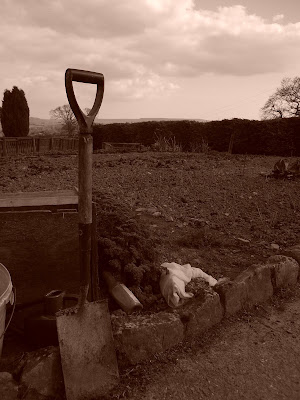
My grandparents' shovel on the farm down the lane from where I grew up.

DIGGING -Seamus Heaney

Between my finger and my thumb   
The squat pen rests; snug as a gun.
Under my window, a clean rasping sound   
When the spade sinks into gravelly ground:   
My father, digging. I look down

Till his straining rump among the flowerbeds   
Bends low, comes up twenty years away   
Stooping in rhythm through potato drills   
Where he was digging.

The coarse boot nestled on the lug, the shaft   
Against the inside knee was levered firmly.
He rooted out tall tops, buried the bright edge deep
To scatter new potatoes that we picked,
Loving their cool hardness in our hands.

By God, the old man could handle a spade.   
Just like his old man.

My grandfather cut more turf in a day
Than any other man on Toner’s bog.
Once I carried him milk in a bottle
Corked sloppily with paper. He straightened up
To drink it, then fell to right away
Nicking and slicing neatly, heaving sods
Over his shoulder, going down and down
For the good turf. Digging.
The cold smell of potato mould, the squelch and slap
Of soggy peat, the curt cuts of an edge
Through living roots awaken in my head.
But I’ve no spade to follow men like them.

Between my finger and my thumb
The squat pen rests
I'll dig with it

Tuesday, 3 September 2013

Tool Talk

"With perspectives from archaeology, performance and movement-based research, Labour Movements hosts a conversation on how we decipher, read and interpret tools and their relationship to our bodies."

Should I be surprised that there are other people who are interested and have researched into the symbolism, interpretation and significance of tools?  I'm delighted to discover that there are. Not only does that reaffirm some things I had often thought but it also invites an opportunity to learn some new things too.

On Sunday 1st September I went to The Parlour Showrooms in Bristol to attend a tea break talk discussing, "Tools of the City and Movements of Work"
 
 A brief bit of context: this talk was part of the 'In the City Series', a six week long programme of performance and events running from July to December exploring the themes of making, working and walking (to name a few) within the context of re-imagining ‘The City'. The talk I attended was part of 'Working in the City' and co-produced by KWMC and The Showroom Projects with the talk co-curated by Cara Davies and Labour Movements.

The Venue -Parlour Showrooms, Bristol

I heard of this event through, Paul Hurley, a performance artist working with the theme along with fellow performance artist, Clare Thornton working collaboratively to create a series of performances based on movements/actions associated with tool use/misuse. I had worked alongside Paul on the Context residency at Somerset College around three years ago. Back then I can remember the shamanistic-like use and importance that Paul placed upon what were fairly mundane artefacts; a broken umbrella, a foil space blanket, a cycling helmet, cricket pads and in my own way (through drawing) sharing a common interest or perhaps belief (if you want to call it that) that everyday things had an importance, mysticism or resonance that somehow elevated them just beyond mere things of use.
 
Being still fascinated, if somewhat haunted by tools as subject matter in my own art work (you are reading 'A Spanner in the Workz) I did what any good tool obsessed, blog wielding, bookseller would do and went to investigate...

The following is admittedly a fragmented report that is my attempt to recall what was discussed along with some thoughts of where it sits within my own practice. 


Fuelled by copious amounts of tea and biscuits a small collective of 18 people attended the event inside the Parlour Showrooms (which is basically an empty shop space that is used for temporary exhibitions situated on College Green in Bristol). I liked the informal atmosphere of being surrounded by other people's tools (see photos) on the walls and sitting on wooden benches and having mugs of tea. It all seemed more relaxed and fitting (in a DIY sense) to the nature of the conversation.   Hosted by Cara Davies, PHD student and featuring two speakers the conversation began in laying some foundations:

 What is labour? What are tools and how do we interpret them? To be discussed from archaeological and bodily perspectives.

 Speaker number one was going to discuss tools from an archaeological perspective, discussing the interpretation and typology of tools (how things turn into other things over time i.e. Can be seen in the evolution of bowls or spoons in Pitt Rivers). How do we identify, describe and use tools? In turn who decides the correct/incorrect use of tools, is there a hierarchy of tool use and a more political look at how tools control and need to be controlled. All pretty ambitious to cover in a forty-ish minute conversation methinks and that is probably my only criticism of the event, that it promised more than it actually delivered (breadth rather than depth). However, maybe that’s not entirely fair as it was only supposed to be a conversation and in many ways opened up some interesting discussion and points I had not previously considered.

 Anyway, the group were given four scenarios which presented different ways in which ‘tools’ are used, for example, a macaque washing a potato in a stream is an example of using nature (in this case the stream) like a tool. The other examples included tools that have to be learnt or that knowledge is required to use them, tools which are intentionally broken as a symbol for the misuse of tools and lastly people referring to themselves (the body as well as politically*) as tool. Those examples were given as a way of opening up our interpretation of what a tool ‘can be’ when we think about the tools used to create the city, populate it and influence its structures of control, navigation, identity and so forth.
 
The concept of mega tools and micro tools was presented with mega tools being tools which control such as roads, traffic lights, keep out signs and anti-climb paint. Whereas micro tools act against mega tools and are more about how we use our bodies in ‘tool-like’ ways such as creating desire lines, open footpaths, guerrilla gardening, using muscle memory. This doesn’t mean they are always necessarily always in opposition to mega tools but are a kind of cause and effect of the controls that mega tools induce. I wonder how these see-saws of conflict are balanced or attempted to be controlled by those in power. Graffiti is another example of breaking tools, in the sense that a spray paint can wasn’t originally intended to paint walls but was used that way as a form of taking ownership, creating individuality in a public space. In that way tools also become a form of creating ‘self’ as we identify in different ways with different objects.

It wasn't all serious, we also had time to play 'Guess What It Does', with this selection of odd tools.  No prizes however for guessing that the best answers were actually the ones that turned out to be wrong.

The conversation flowed into more of a discussion into using tools and the misuse of them. And it is this thread of conversation that brings us on to speaker two, Sang-Gye, a Tactile Responsiveness Therapist who presents a more bodily awareness of the actions associated with tool use. As a practicing Buddhist and as part of her therapy she treats people holistically, mind and body are linked as one and explains that when we are born we have no physical habits and that actions and how to hold things/use them are learned and in turn can be mis-learned (if there is such a thing as mis-learning a tool? As it is surely only through mis-use that new things are created?). This is similar to how an apprentice has to learn, experience and experiment to become skillful at using a tool previously unlearned. She explains gesture is learned and in turn gesture turns into a habit of movement and movement becomes posture and posture changes your body (we shape our tools and therefore our tools shape us –in this case physically, but also in terms of identity).

 It was interesting to hear what people had to say about their own relationships/experiences with tools of their trade and how the physicality often associated with those actions is now being replaced with new technology, screens and touch-based operation systems. This led to discussing how people learn to use tools correctly, to let it do the work, so-much-so that if done properly you actually forget the tool altogether. Queue Natalie stage right.  "In my own practice using a tool (ie a hammer) to create a drawing, the repetitive action of using the hammer made me increasingly less aware of the hammer itself and more aware of the materiality of the carbon I was hitting to create the drawing." Although all this talk of the action and gesture involved in using tools did make me wonder again whether performance is a more effective medium to convey both the physicality of tool use in a way that draws attention to both the tool and its function in unison? I was also surprised at how elegantly simple ways of presenting tools hung up in a white space also works really well at drawing attention to the objects.


The conversation ended how it began except with fewer biscuits and the addition of even more questions, but we had been on an interesting journey that had raised some new ideas and ways of thinking which would have never been generated if not for the curation of the conversation and prompting of discussion which all in all was good. Maybe we would all think differently about how we moved through the city on our way home, how we were going to use that shovel properly next time we were gardening or spend less time using digital tools and start using real ones more often? And at the very least had all come to the profound realisation that, 'hey there are other people that like tools as much as me'. Weird!

Retrospectively my thoughts are that the simplicity of how the tools were presented on the walls within the space somehow helped prompt such thought provoking and interesting discussions. It made me wonder if maybe in my own practice should I have written or talked about tools, made sound recordings of tools instead of forcing to convey it through drawing or representation? Generally speaking, is the simplest idea always the most effective one? But then I don't think I was ever dedicated enough to the idea of tools as I was to drawing, painting, mark-making, printing and the substance of all that archetypal art stuff which provided  a limitless source of joy and self-expression. There has always been an on-going conflict between the two and whilst my hands and things I drew with were in ways tools it still never seemed enough to justify the reasoning to draw tools. On the other hand, my work has always had the look of being laboured (lots of mark-making, gesture, large scale) and maybe that in itself is somehow synonymous of the work associated with tools as objects of use? It’s clear that this subject isn’t going to go away any time soon and remains something of a personal mission that instead of reaching any conclusion continues to be picked-up and battled with. Only the medium has changed to words rather than paint these days. Things could get messy!

Find out more about The Parlour Showrooms and future 'In the City Series' events via the links below:

Not forgetting websites of the participating artists themselves:

*NOTE TO SELF an example of this being: “The Master’s tools will never dismantle the Master’s house” –quote from Civil Rights Activist, Audre Lorde

Friday, 30 August 2013

That's a Wrap!

A celebration of the mundane, if I'm not posting about painting windows it's tools (or things to do with them) and this week is NO exception! Seeing is believing and arriving at work to find a new range of wrapping paper proudly hung on display beside the till shouldn't have been anything to get excited about but imagine my delight upon discovering tool covered wrapping paper!

I know!

 This is probably the most exciting development in the study of the mundane since reading the writings of Georges Perec and Nicholson Baker in 'The Mezzanine' (brilliant books).
It's wonderful. So I bought a sheet of course. Do I need wrapping paper? Answer, no, but then think of what I can do with tool covered wrapping paper.....

I could:
1) Use it to cover sketch books and GCSE French course text books I no longer need
2) Line the bottom of my drawers (as in the furniture kind, before you get the wrong idea!)
3) Turn it into a real tool peg board and use it to hang tiny tools off of
4) Buy more sheets and wallpaper the downstairs loo
5) Cut out the tools and create miniature collages and reliefs
6) Frame it and hang it on the wall
7) Turn it into a stylish paper aeroplane
8) Use it to serve fish and chips in (I'm aware, very ostentatious) 
9) Wear it as an origami hat
10) Make a tool covered pinwheel
11) Make a paper wallet
12) Tool paper chain

Or maybe even use it to wrap something..., like tools maybe (!) Or would that just be too much irony?


On a more serious note you can check out work by Sam Brewster (who designed this paper) and more inspiring paper designs by really interesting illustrators at Wrap Magazine (links below). Maybe I should use this as an opportunity to comment on 'good' design, shape, form, colour and illustration in general, but I probably don't need to, as it's already there. Another day perhaps!


p.s If you'd like to know where I bought said paper then there's a big hint in the labels below. Heck, you may even want to buy some to wrap a present for me in one day....(or not!)

Thursday, 22 August 2013

I'm a user

“She found a little bottle…and tied round the neck of the bottle was a paper label with the words ‘DRINK ME’ beautifully printed on it in large letters."
- Lewis Carroll, 'Alice's adventures in Wonderland'

Ah, welcome to sunny Oxford, Wednesday 21st August 2013.

If Baudrillard in, his 'System of Objects' is correct in saying, "...there are two functions of every object, to be put to use or to be possessed" then this shop would surely appreciate both. 'Objects of Use' on Market Street in Oxford sells, you guessed it, things of use and things (like any self-respecting shop that wants to earn a living should) to be possessed if you're willing to cough up the cash that is. And if you're not familiar with this blog, its not my habit to go around applying theory to shops, it just so happens that this shop had something in common with my interest of everyday objects (drawing them mostly -check out the artwork sections of this blog).


After being to visit Pitt Rivers, Oxford earlier that morning and admiring (as I usually do) the collections of tools, netsukes, keys, pigments and such, I realised that what is particularly appealing about Pitt Rivers is the way in which the objects are displayed and the way in which they are labelled with their original handwritten tags (ah see, maybe you were wondering why the Carroll reference at the beginning...and he studied at Oxford too, which is convenient for this post). Later, coming across 'Objects of Use' was a bit like walking in the shop version of Pitt Rivers where things were for sale but presented as though they were on display. The shop was more empty in terms of stock than I was used to, except it was empty in a less-is-more way, where each comb, trowel, pot, pan and pair of scissors was given its own space to hang or lie. The result is an impression that each object is of greater importance and more 'one-of-a-kind'. And why shouldn't it? If we all (as users/makers of objects) took more notice of the things we use and in turn more care in looking after them then maybe that could help us all become a little bit more sustainable...maybe.


On other thoughts, I have often pondered on the difference between an object and an artefact. Is an artefact really just an object with provenance/museum context? Or in general does it really matter what we categorise or label something to be? Is a hammer still the same whether we call it a tool, a thing, an object or an artefact? I don't expect to answer these now, but it is something of an on-going interest. 

So anyway, back to this business of labels, everything in this place has its own label complete with story of where it was made and what its made of. Yes, you too could own a wild boar hair men's hair brush made in Germany! Funnily enough, I didn't buy anything, realising I had probably enough objects of use at home that I could attribute my own provenance and history to. Of course I am a bit cynical here and can kind-of see the shopkeeper psychology at work, trying to get customers to buy premium products that are presented uniquely and given an almost superfluous back-story so that it can be justified at being priced at a higher cost, but none-the-less I think it works and having worked in retail agree that with the increase of online shopping the pressure for high street shops to offer, 'something more', 'added value' or an experience is the new norm. There's actually a lot of creativity that goes into it and I cannot help think of the Andy Warhol quote, "When you think about it, department stores are kind of like museums" I cannot see why this shop couldn't be art? Maybe a lot of shops are? 
 
 
Check it out! -  http://www.objectsofuse.com/
 

Friday, 26 July 2013

I'm looking in

Last Saturday saw the opening of 'Oustide In: West' at Taunton's Museum of Somerset.

 "Outside In: West celebrates the extraordinary creativity of 21 artists outside the mainstream.  It has been arranged in partnership with the Museum of Somerset in Taunton, and showcases artists who have remained at the margins either because of health issues, disability, or social circumstances.
In selecting the powerful and often exuberant work, the exhibition has centred on gesture, narrative, expression and vitality. On the surface the work seems wonderfully diverse, but delve deeper and two themes emerge."

So there's a little bit of context for you.

Greetings!

 I missed the opportunity to write about previous exhibitions at the Museum so I wasn't going to let this one pass me by and Tuesday this week decided to give 'Outside: In' a look-in! Not only that, but there was of course the usual personal reasons for going (what with Taunton being the epi-centre of cultural happenings and all...) of said art protagonists, Tim Martin and Stuart Rosamond selecting/curating the exhibition and artist Brian Gibson (whom I had the pleasure of sharing a residency with a few years ago as a part of 'Context') whose works are present in this exhibition. What I think was going to originally be two exhibitions shown simultaneously at the Museum of Somerset and The Brewhouse have now been condensed into one exhibition at the museum (in light of The Brewhouse's closure). Hence one half of the room is themed as 'Self and other portraits' (pretty self explanatory) and the other (more ambiguously) 'From within and from without' ("works that express personal thoughts and inner feelings as well as perceptions of the contemporary world"). Although none of that made really much difference at the time as I was more interested in the varied assortment of work on offer (of which I was pleasantly surprised).

Enough ado, what of the work?! Being an outsider art exhibition I was expecting a lots of angst and intensity and it was refreshing to see so many works that used humour, 'Bad start to the holiday' by Ideapathic and Regina Lafey's works (pictured below) as well as works that were greatly enjoyable and witty, such as, the jazzy and colourful painting 'Aenigma' and 'Brass'. What was also exciting was some of the diversity in both drawing/painting style in the 2D work and use of materials and inventiveness with the 3D pieces. 'Floral Tribute' by Joolz Cave-Berry (pictured) made of buttons and wire automatically reminded me of Jim Lambie and I liked thinking of how a process of threading/collecting the buttons onto wire could be meditative and maybe even cathartic in its repetitiveness. Similarly, Arron Kuiper's 'Gel paintings' (pictured) where oil paint is implanted into gel, as though the paint is suspended in space are simply like nothing I have ever seen before, they are really engaging and curious to look at. Though, like any good art exhibition, I'm pleased to say this one is not completely devoid of some darkness and mystery such as, 'Loosing my heart to dad' Steve Lydoon and Benjamin Fish's 'Masked' which had a really loose sketchy quality that reminded me fondly of the brilliant and edgy illustrations of Ralph Steadman.

Not pictured here are Vivi-Mari Carpelan's photo montages which have a great feeling of nostalgia and sort of Jan Svankmajer-feel of surrealism (familiar and yet very strange/carnivalesque) and underlying unsettledness. They are all a little surreal with even the more abstract works like Grade One's use of gloss paint and layering to create circular motif has a sense of purpose about it that sort-of charges it with a dream-like feeling of powerful symbolism or mysticism. And in a way that is the charm and strength of Outsider art generally, that it the work never feels 'half-hearted' but instead, whether the work is laboured or spontaneous it projects a sense of meaning something, of relevance and importance-that it has been made because it needed to be made, to be expressed. You may argue that all art functions that way, but I suppose what I'm saying is that there often seems to be a more raw, perhaps more genuine reason/need for that creativity present in the work of Outsider art than that of work which is more preconceived/conceptual. Or is it the often child-like, naïve accessibility that characterises a lot of Outsider art that creates a different expectation on the viewer forcing us to look at the work differently? I speculate because there is no definitive answer and I realise that some Outsider art is quite the opposite and can be incredibly complex and detailed, but either way the underlying quality is one of being-human, that there is always a strong sense of the artist being present in the work and in turn it making its own connection with you as the viewer.

Overall an exhibition that was a great follower to seeing 'Souzou Outsider Art from Japan' at The Wellcome Collection, London in May. Souzou translating as either creation or imagination in Japanese, which is fitting as this exhibition also has both.

Not only that but the Museum of Somerset also gets bonus points for allowing photography and being genuinely helpful, good stuff! As far as exhibition spaces go, it is in my view, unquestionably Taunton's best exhibiting space at present and although fairly small is a really smart, clean, light gallery space that has so far demonstrated great potential if it continues to exhibit work, like this exhibition, that is local, technically accomplished, interesting, fun and thought provoking.

That and there's some really weird and wonderful things in the actual museum itself!

Roger Davison 'Stooping Figure'
Regina Lafay 'Crutches'
Brian Gibson 'The Red Deer'
Joolz Cave-Berry 'Floral tribute'
Arron Kuiper 'Rowan'

'Outside In: West' is on at The Museum of Somerset until the 28th September. Tuesday-Saturday (10:00 -05:00)

It's FREE entry (so no excuses!)

 http://www.outsidein.org.uk/

Sunday, 21 July 2013

You want proof?

Nice!
 
A brief mention, to celebrate receiving my first ever free requested book proof since I have been a bookseller (six-ish years). Not that proofs are that hard to acquire, in fact quite the opposite, it's just been that working part-time I had never thought/or had much time to email publishers asking before. But when I heard about a new Donna Tartt, I thought I'll make an exception! Thank you Little Brown Publishing for sending it my way, you are AWESOME! Hopefully, Donna Tartt's 'The Goldfinch' will live up to the expectation as her most well-known for novel, 'The Secret History', which is definitely in my personal top ten greatest books of all time. It's a bit of a tome, so not the sort of thing I can carry about on the move, but perhaps the perfect book to read at home over the loooong boring summer.
 
The book's not out until October 22nd, but here's a blurb to get you interested:
 
Aged thirteen, Theo Decker, son of a devoted mother and a reckless, largely absent father, survives an accident that otherwise tears his life apart. Alone and rudderless in New York, he is taken in by the family of a wealthy friend. He is tormented by an unbearable longing for his mother, and down the years clings to one thing that reminds him of her: a small, strangely captivating painting that ultimately draws him into the criminal underworld. As he grows up, Theo learns to glide between the drawing rooms of the rich and the dusty antiques store where he works. He is alienated and in love - and his talisman, the painting, places him at the centre of a narrowing, ever more dangerous circle.
 
The Goldfinch is a haunted odyssey through present-day America and a drama of enthralling power. Combining unforgettably vivid characters and thrilling suspense, it is a beautiful, addictive triumph - a sweeping story of loss and obsession, of survival and self-invention, of the deepest mysteries of love, identity and fate.
 

Once I've read it I'll be reviewing it here on my book blog in October, The Groaning Bookcase, well worth a look:

Monday, 8 July 2013

Contains art is unleashed in Watchet!

On Saturday 6th July at 4pm the Containers at Watchet were officially opened. I popped down on the bus to see the art contained within and of course have a glass of the elderflower champagne I'd heard so much about....
Avast there! The Contains Art flag, proudly aloft in the Watchet breeze.
Quite a crowd of discerning artists and alike turned out for the opening, for which there was booze, bunting, falafel, postcards and sunshine.
For those of you wanting a bit of context to this event then please read the following:

"Contains Art provides flexible, affordable space for artists, designers and makers to develop and showcase their work and to connect with the creative and wider communities of Western Somerset."

Set up in July 2013 by artists and volunteers the containers located on Watchet quay will host studio spaces for several artists and a temporary exhibition space to be hired out.


Does what it says on the tin.
Beautiful boat next to the containers, perfect for some inspiration.

The studio spaces themselves are a good size, they've been finished and built to a really high standard, have more light then I though they would (due to inserted windows/window doors, obviously), electric and smooth white walls to produce/hang work. There is a lack of running water/toilet facilities in the studios themselves, which could be a problem but the containers are located next to public toilets and there is running water taps located on the quay that the artists have liaised to use. Practical stuff aside, the location and community of fellow artists in containers and buzzing arts scene in Watchet and Minehead make up for a few technicalities.  It was a fantastic atmosphere at the Containers on Saturday afternoon with much cause for celebration and many thanks rightly went to those who worked hard to make it happen. A bottle of that very fine elderflower champagne was cracked open against the containers to signify the 'official' launch and long may they reign, in my opinion, it is a truly great idea and use of space.

Another added bonus to the day was being able to see the entries to the postcard competition (of which I mentioned on this blog a couple weeks back http://spannerintheworkz.blogspot.co.uk/2013/06/wish-you-were-here-contains-art.html). Good to see so many entries and even better that quite a few had sold. Whilst viewing work in a container, due to its length and limited viewing distance, took a bit of getting used to, I think for the postcards (which are smaller) actually worked really well. I also think it's it's an interesting opportunity to have a gallery that is a challenging shaped space to work with as it could result in some unusual creative responses. What was also refreshing is that this exhibition was fun, it was great not knowing whose postcard was whose (although I enjoyed trying to guess a few) and there was a real mix of styles and ideas.

Glad to see the art in the containers finally unleashed to the public and I really look forward to seeing what's in store next....

Recognise this postcard? I think it's sold...
A few of my favourite postcards now, it's all anonymous so do let me know if I've picked yours! This one seems apt given the harbour setting, the surface looks like a weathered and worn hull of a ship or indeed a container. 
I'd know that yellow plastic anywhere! It's a SAW sign. Good to see it being recycled! Also like the cows which on first glance look like a fused two-headed beast. Weird-I like it!
This reminds me of a Susan Hiller series of postcards featuring stormy seas. Or a Peter Lanyon. The two aren't necessarily connected its just a few reasons why I was drawn to this postcard.
 This is one of a series of...lino cuts, I presume, from a Cornish artist in St Ives. An additional card with some poignant words and advice was displayed alongside these. It went something like this:
 'Dear Watchet, Advice from one seasoned harbour to another, Your sea may not be as blue, but your strong stone harbour walls are just as strong and beautiful. Your lighthouse is beacon red, mine sea spray white. Don't ever let the seagulls get the upper-hand, your ice cream eating promenaders will never forgive you. Keep your galleries small and ensure your artists stay true--make sure they use the right blue. My sands are white, a colour favoured but your layered red rock holds secrets of old, fine fossils and pink alabaster. The famous have trod and been inspired by your shores and yet your secrets are still hidden, yet to be explored. Not leeched to a cliché. With love from St Ives x'
Superb.