Monday, 11 August 2014

For what its Wirth

Rumour long foretold of an affluent, prestigious, world-class, contemporary art gallery whose arrival in a small rural town in Somerset was going to bring much joy, prosperity and branded re-useable tote bags throughout the vale. Its name, Hauser and Wirth and we had all been waiting with great expectation for the opening of its latest gallery in Bruton, Somerset this summer. Sharing its name with its other established galleries in London, New York and Zurich, Bruton might not seem like the obvious place for a commercial city-based gallery to set up, but with a gap in the art map that sees Bristol and Bath already hosting our largest contemporary art centres, there was perhaps an opportunity to establish some of the arts market elsewhere. And as the Somerset creative community have already proved, we don’t let being rural get in our way and continue to ensure, ‘there’s art in them thar hills’, often whether people love it/want it, support it or not! Maybe it is our resilience superseded only by our beautiful scenery that inspired the owners of Hauser and Wirth to bring a slice of the city to our middle of nowhere! (or possibly that the gallery’s owners send their children to school in Bruton?... although I prefer  to think it was a bit of both)    

Whatever the reason, Hauser and Wirth's arrival provides a fantastic opportunity to form new links between Somerset and the national/international contemporary art world as well as encouraging more tourism to the area. Now nearly a month has passed since it first opened its doors to the public I went to visit and find out for myself if it all really was ‘wirth’ the wait (forgive the puns, I can’t help myself!)

Subodh Gupta's 'Untitled' (2008) stainless steel bucket in the courtyard of Durslade Farm.
 
Set in the grounds of Durslade Farm, (a former piggery, barns and stables around a central courtyard) Hauser and Wirth boasts five gallery spaces equating to a total 2483 square meters, a one and a half acre meadow garden designed by Piet Oudolf, education rooms, studio spaces and Bar/Bistro.  It is hard to find fault as it is, all without question, beautiful. The standards of design, detail are high from the practical layout of the car-park to courtyard entrance complete with its own outdoor sculptures; a giant stainless steel bucket by Subodh Gupta and humongous bronze by Paul McCarthy (amongst others) to the gallery rooms themselves which feature both contemporary white-walls and spaces where they have retained the original barn features, beams and brick walls. The bar and grill is one of the gallery’s unique highlights and features a bar made from a mêlée of scavenged materials from railway tracks and fragmented paintings on wood with an equally impressive cloakroom, described as ‘a unique installation’ made from industrial lockers and paint cans. I assume it is there to be used...?

Paul McCarthy's 'Ship of Fools, Ship Adrift' (2009-2010) Bronze. 
 
Although this perfection comes at a cost too and I fear its ‘middle-class chic’ could brand Hauser and Wirth Somerset as a place stereotyped to the well-off, retired/middle aged or readers of Country Living magazine. There is nothing wrong with any of those groups per say, as they do make a significant majority of the audiences that view/invest in art in the county (and indeed I have my suspicions they are one of the target audiences Hauser and Wirth are looking to attract, after all they are a commercial gallery) however even though I have studied and seen much art in my modest 27 years, I still felt slight trepidation created by the air of fanciness at Hauser and Wirth, as though such a place was not for the likes of me, that my worthiness of being there was somehow dependant on how many interior design books I owned and kept on my Ikea coffee table (the answer is none by the way, I don’t even own a coffee table!). This was, in part a misconception that was soon dispelled by the friendliness of the staff. I did just come to 'see the art', but as this post proves I often find the context of the art world more distracting in than that of the art work itself.
 
I predict that attracting a wide variety of audiences is Hauser and Wirth Somerset’s greatest challenge (and one that, notably, is shared by many other arts institutions) especially now they are unable to rely on the passing footfall of their naturally busy city venues, this rural and remote gallery will need to ensure that they make an effort to attract and not isolate a wide variety of audiences through its doors (a few road signs to it wouldn’t go amiss either!?) Hauser and Wirth has been successful and got off to a good start in the way it hasn’t just muscled its way into this community simply by throwing its wealth around, it has employed local builders, artists, residents and looked to the local town’s businesses for support and partnership. At present it seems that they are achieving a diverse audience in having learning/events programmes as well as residences with local artists that look to engage with the wider community. I can only hope this is sustained and grown upon in the opening months as it continues to live up-to its reputation and forge new links within the South West.

Louise Bourgeois 'Spider' (1994) Bronze, silver nitrate and brown patina, granite.
 
Its danger of inclusivity could also be helped by the omission of some of its rules which are handed to you on an information sheet on arrival. It feels a bit unnecessarily protective and a negative way to welcome visitors, ‘Please do not drop litter’ being one inane example. I’m not saying you shouldn’t have rules; I am perfectly mature enough understand the sense of not dropping litter or need to protect thousands of pounds of artwork from the onslaught of many fingers poking it, but if anything fills me with a mischievous sense of anarchism it’s when rules are created at the expense of trusting/assuming people have any common sense.  Broadly speaking, it does highlight the problem with Art gallery’s dictum of wanting more people to engage and interact with them/ understand them, being met by their contradictory set of ‘Don'ts’, “we want you to come into our gallery but whilst your here could you engage with the art only by just looking at it, talking’s ok, just don’t do it too loudly and make sure you don’t run, touch, climb, photograph anything but we hope you’ve had an immersive experience.” Perhaps it is unfair of me to vocalise this concern in a post about Hauser and Wirth when it is an issue that affects many arts institutions. I just think that Hauser and Wirth can only seek to gain and would not damage their image of being a professional gallery, by relaxing some of their rules, trusting the general public and their gallery stewards to protect the work. Relax a little!
 
Phyllida Barlow 'Untitled Gig' (2014) Fabric, paper, cord.
 
The opening exhibition was always in danger of being over shadowed by the gallery itself, however an excellent decision to choose sculptor Phylidda Barlow, whose work could easily compete for attention, made a grand opening impression. Her bold/colourful, mixed media (often suspended) installed sculptures do a fantastic job at both invading, if not dominating the space as they do at drawing your attention to the gallery’s architecture and potential.  In some instances they actually block and act like obstacles that have to be navigated either through or around the edges of the room. This is intentional by the artist whose work is, I think, also incredibly playful being both abstract and looking-like objects such as chairs, megaphones, machinery and pompoms. Barlow makes use of strips of coloured fabric, rope, polystyrene, modroc, cardboard and other inexpensive or everyday materials which she manipulates on a large scale in response to the space (think Arte Povera). For me, Barlow’s work is interesting in that it tricks you into being unsure how to determine the weight or density of her work, of which I’ve also seen some of in the Venice Biennale; and appears weighty/heavy in its mass (due to its often large scale) but light at the same time (due to the airy materials she uses). They are quite rhythmical and dynamic in their compositions as well reminding me of paintings by Vorticists, like Wyndham Lewis and looking at them I feel tempted to take a photo so as to flatten them into these remarkable 2-D compositions so I can be aware of the many different works created by viewing it from different angles. Undoubtedly in my mind, it was a bold opening first exhibition that will have created an impact without being too controversial, conceptual or particularly challenging. Perhaps a safe bet, but then it would do no good in alienating people on the opening of its first exhibition.
 
Phyllida Barlow 'Untitled: Grinder' (2014) Plywood, paint.
 
Good things do come to those who wait as Hauser and Wirth Somerset certainly proves. For me personally I find it all a bit similar to the Damien Hirst affect in Ilfracombe. Hauser and Wirth, like Hirst, has the will, the professional business knowledge and money that are needed to fund what are ambitious and impressive galleries, fill them with international art and bring them to these remote rural areas of the South West. However, in order to thrive they must be supported by the public and continue to work with local organisations and local artists; many whom have lived and worked in these areas sustaining the arts for a long time and have equally long had the ambition, the knowledge and desire to do similar things but have struggled to develop under lack of funding or been eradicated completely due to the 2010 Arts Cuts. It is vital that they work together.  Hauser and Wirth Somerset is a great asset and more importantly than the place itself is the impact it will have on the surrounding area, what it may breed and inspire...only time will tell.


Phyllida Barlow's 'Gig' is on at Hauser and Wirth Somerset until 2nd November 2014.
For more details please visit: www.hauserandwirthsomerset.com

Wednesday, 23 July 2014

What's the word?

If there was a message saying, ‘you will write about this exhibition' at 'Barber Kruger', Modern Art Oxford, then it was subliminal.  
 
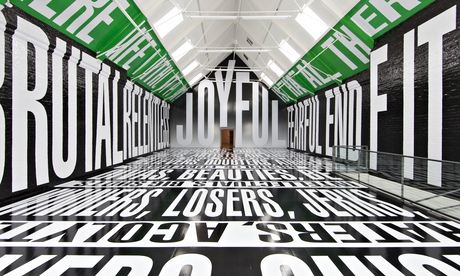
 Wandering through one of the text-filled installations that Barbara Kruger is synonymous for, immersed in the overwhelming scale of the black, white and green text that ran floor to ceiling in the main room of MAO I felt worryingly desensitised to the whole experience.  I say worryingly given the fact that a fellow visitor, of more elderly years, was so affected by the floor to ceiling bombardment of text and slogans that he tentatively stumbled, as though unsure of where the floor had gone, disorientated by the whole experience. For myself, perhaps being from a generation that has been more subjected to the bombardment of images, words and communication that are also faster and more readily available than ever before, it is harder for printed text to have impact, a victim of its familiarity. This is not to say that Barbara Kruger’s work has completely lost its impact, as the current exhibition of the artist’s work at Modern Art Oxford aims to prove, but it is possibly in danger in the digital age of news, advertising and social media of becoming more familiar, less hard hitting than what it once was.

 
Emerging from America in the early 1960’s Kruger made her impression on the art world with her adaptation of advertising language and imagery which she used as a social commentator and political agitator to provoke questions about assumed viewpoints on capitalism or femininity through graphic media of text and image. From a background in graphic design, working for a small independent women’s magazine her art work often favoured the red, white and black (like the tabloids) featuring often classical or iconic imagery that she juxtaposed with contradictory or perception altering text. Her wit and edginess ironically perhaps saw her slogans becoming commoditised into bags (‘I shop therefore I am’) and reproduced as posters turning them into some of the most recognised images from the pop art era.
 
Certainly the large installation at MAO is almost too much to take in making it so that any message, any meaning that the words may have on the walls/floor are lost in the noise of a hundred other messages all shouting for your attention at the same time. Perhaps this is the point, that there is a loss of anything meaningful and words become mere shapes, formal components in a space when you have too many things competing with each other at once? The most successful use of text in the main installation, as it has the most affect, is the word ‘JOYFUL’ in huge letters filling the wall you enter in. It’s simple and works well in drawing your attention to the height, space and shape of the room, (which is described as ‘cathedral-like’) but if anything is more intimidating in its authority in size, that is more bossy than actually encouraging any genuine feelings of joy. Personally, I think this is quite reflective of how most advertising works in the sense it presents a good-thing and forces you to like it clouding your own judgement as to whether you really need it or not.Well worth watching as well is the impressive and mesmerising feat of how the work was installed in a short time-lapse film.    


For me though, Kruger’s smaller works have more to say and impact than the more superficial room installation. A simple observation of, bigger is not necessarily better is evident in the example, 'Your Misery Loves Company' where the juxtaposition of a dentist’s drill and wording, ‘Your Misery Loves Company’ is much more unnerving, hard-hitting and lasts in memory more than anything in the installation. Some of the messages in these works may have lost their relevance over time but their ability to have impact has not.  Her directness to mass audiences and ability to provoke/challenge using words and strong graphic imagery has influence that makes up some of the fundamentals of street art; one example being Shepard Fairey’s Obey posters and iconic Obama Hope poster. Kruger’s work was one of the significant players in taking the familiar language/media of advertising and newsprint and subverting it to create new meaning. More recently artists such as 2012 Turner Prize winner Elizabeth Price use Kruger influenced text and image in film montage to great success. The interesting question now, is where Kruger’s work sits today, with, as I’ve already alluded to, more modern/digital forms of communication and less use of print?
The answer can be found in Kruger’s most recent pieces where the artist has used film. They also make up the more relevant and interesting pieces of the exhibition. ‘Plenty LA’ from 2008 flashes the word ‘enough’ at the viewer repeatedly amongst still and moving images of sunsets, a handbag, car with a smashed bonnet and ‘bling’ encrusted mobile phone; a direct Kruger-esque comment on consumerism, whilst in ‘Twelve’ faces are projected on the walls argue with one another (about relationships from what I gathered), their real thoughts read across the bottom of the screen like news coverage. This work is more topical in its use of modern technology and its use of a reality TV-style of drama or dialogue that has come full circle from being first intended to present a view of reality to now in fact being completely unreal in its superficial-ness.  The viewer enters awkwardly into the middle of these arguments that feel at once staged and fake but believably real at the same time. It is an observant and is a slightly troubling comment on our current society that we chose to trust the authenticity of the news reel text as to the spoken words of the actors, but this is what Kruger does best. In ‘Twelve’ she takes a familiar mode of presentation used in the media, the news reel and subverts it into manipulating how, in this case we respond to what is a very social/domestic situation. It is far more subtle than her printed work from the sixties and therefore accurately demonstrates the change in media/advertising to becoming more subliminal.
 
New and fans to Kruger’s work will get the most out of this exhibition that for me, acts more as a retrospective than being completely  fresh or ‘of the moment’. I don’t think this is entirely Kruger’s fault, but more that her message that once protruded so edgily on the walls of modern art galleries or shopping bags now feels too accepted and familiar to remain that provocative. Your modern-day Kruger is now more likely to be found tagging a subversive message on the wall of a public building or generating some of the many political satire games/images that pop-up on blogs, forums and Facebook pages, they’ll be creating flash mobs, guerrilla knitting and attempting to go viral with videos and tweets that raise question to accepted normalities. Such is the plight in the age of uncertainty they probably won’t even call themselves artists.
 
Barbara Kruger is on at Modern Art Oxford until August 31st 2014.


Tuesday, 22 July 2014

Kitsch you like...


As a bookseller it is my sworn duty to from time-to-time inform you of some of the lesser-known marvels/oddities in the world of books...

In that tradition and as a bit of fun following on from last week's Art School related post, I found an old copy of a manga set in an Art School in Japan. Yes it seems that there really is a manga for almost everything making it in some ways unsurprising to find one set around the highs and lows of studying art (because who wants to read about monsters, martial arts or robots when you can go to art school?!)
None-the-less it is still pretty weird in its extremely kitsch, exaggerated and humorous take on what ordinarily should be a fairly mundane topic (although anyone who has studied art will tell you in reality it is anything but  mundane or uneventful). Manga, Anime and Japanese culture has an amazing ability to take almost any profession, lifestyle or activity and make it cute, quirky or interesting (think 'Harvest Moon' for farming). You only need to look at the amount of time/detail given to everyday activities such as preparing food in virtually any anime to realise this. The more mundane it seems the better and a refreshing difference to the attention grabbing pace of a majority of Western animation.

 G.A is sublimely silly, don't expect anything deeply revealing in what is more a comedy of relationships and mannerisms that happens to be set in an art school. Peppered with tips and facts on paints, colour mixing and drawing materials younger readers would probably learn something too, its the sort of book I would have loved as a kid (and in many ways still do!). The whole thing is far sweeter, cuter and innocent than the real thing but that doesn't take away from the occasional amusing, true-to-life observation that makes reading it worthwhile.  

And if you really enjoy it there's a whole series!

Sunday, 13 July 2014

Another brick in the bookcase

Ah the perils of working in a bookshop. In between the day to day mishaps and writing my next blog post I came across (actually it sort-of interrupted things) a brilliant book, 'Art School: Propositions for the 21st Century'. Bringing together a collection of essays, interviews and case studies from Arts institutions, arts educators, critics, former students, curators and artists around the world it is the perfect read to dive in and out of and as I have found already, contains some magnificent, inspiring and accurately insightful observations/ideas that extend beyond the thinking that this is a book primarily concerned with 'teaching' or 'education'.
Everywhere you read and virtually everyone you talk to about arts education at the moment has a pretty bleak view on its future. 'Things are most definitely not what as they once were!' Simply the way art is taught (if you are among the few who believe it can be 'taught' at all) seems to require an approach that is more experience driven/unique to the more conventional sides of teaching and perhaps has therefore unjustly suffered (despite a long fought resistance) in the hands of those who don't understand it; often perceived for its being at odds when forced to comply with more institutionalised ways of educating instead of being supported/understood in its own right. Where some open minded institutions may adapt and thrive under the pressure to conform, narrow minded management on top of squandered resources escalated with cuts in arts funding nationally have been met with an increasing anxiety that has seen many arts establishments buckle. The emergence of independent art schools and artist-led art schools in response to these failings, backed by the growing student dissatisfaction spurred by increases in tuition fees is in some ways unsurprising and raises the important debate that there is a considerable, valid and perhaps long overdue need for reviewing how future generations of artists will be nurtured. 
I think these are issues that affect all artists, particularly those considering or beginning their art education but also to those who have been through these experiences already and/or continue to work with these institutions. How the concept of the art school evolves, reinvents itself over the next few years, I speculate will have impact on where our innovative thinkers/makers come from, how we value art (in the broadest sense of the word), where will we cultivate/inspire future generations of artists and how art proliferates to work with other disciplines. Without having read the whole thing yet I think this book goes someway at offering some potential solutions those questions.
Personally, I am still trying to unravel the mysteries of my own art education that continue to have impact on my thinking and decision making in and outside whether I am making art or not, whether I am successful in my art pursuits or not.  It is one of those rare experiences, of the kind that tend to stick with you and influence who you are and how you react to life's situations.
I've had to put posts on Bill Viola and Matisse on hold for now, as it seemed all too important and exciting not to share some of the things I read...

1) The following is one of the best quotes I have found about how I felt in the transition between my formal art education and 'being an artist' in the real world, so to speak:
‘Artists undertake to transform themselves continuously through their practices and throughout their working lives. For an artist there can be no separation from being someone and learning to become someone. The reason to continue to be an artist lies in an everyday rediscovery of what remains to be said or done. Being an artist is no different from learning to become an artist. The process of rediscovery of what it is that he or she needs to do transforms the artist on an everyday basis. The horizons of the artist’s self continuously expand to take in the incremental unravelling of what the artist still desires to inscribe on his or her consciousness and the attention of the world.
The day that an artist realizes that his or her stock of things left to think about and to do has depleted to a point where it measures less than what has been done already , the artist might as well stop practicing. This means that in order to continue working, the artist learns to constantly prepare for the unknown, for what remains to be done. An artist’s education is never finished. School is never out. ‘ –Raqs Media Collective ‘How to be an artist by night’

The whole essay is excellent too and can be read via the following link:

2) It is worth reading this piece in its entirety created by students as Columbia University and reads as a list of creative, observational, political, environmental, social, architectural, strategic proposals for an imaginary potential art school. Factors such as historical context, geography, funding, power relationships, infrastructure, facilities and institutional relationships were considered as terms for generating ideas. I certainly found several things to be very reflective of my own experiences and many others which I thought would be welcome/beneficial additions to current art school programmes.  Extremely thought provoking, self contradictory, silly, entertaining, serious, imaginative, honest and poignant...come to think of it a lot like art! This is the sort of reading that should be compulsory for anyone within the institution of art education; managers, tutors and students alike and for those artists, like myself who still look back in wonder as they continue to make sense of it all.


Nobody asked you to do nothing /a potential school
Report prepared in November 2007
At Columbia University, School of the Arts, Graduate studio program.
Liam Gillick

 NB: This isn't the entire version. I edited it out to include the main points, but stress its worth reading it all. Alternatively highlighted in orange are the few points I particularly enjoyed, if you don't have the time!

Things will be out of sync. There will be a large sauna. The edge will be perceived from the inside and outside simultaneously. The idea of boundary pushing will remain. There will be lots more bicycles. Some surprising things will be free. There will be more difference. There will still be a studio problem. There will be big sheds. There will still be a sense that one is forced to find an activity. Delusion will remain. The question will remain, what kind of space are we in? ...There will remain a focus upon the idea of students choice. This will remain an incomplete project. There will be many places to sleep. There will be showers on demand. There will be the possibility of collective action. There may well be citizen artists. There will be a free, or progressive tuition scale (increasing expense with duration of attendance). There will definitely be massages from trusted people.... There will be a sense that there is less structure. ...Some things will be more mobile. Some people will be more migratory. Some effects will remain local... Some structures will be disintegrated. There will be fewer clear representations of power within the hierarchy of the place. There will be no possibility of an architecture that clearly expresses relationships. ... There will still have to be a building. ...In the manner of pre-schools there will be reading lofts and soft places to rest. ...Incomprehensible wealth will circle the school. There will be no equilibrium...Who is them will remain a reasonable question...There will be a reduction of appropriateness. There will be an increase in duration. Some will explore the potential of every possible resource. There will be large scale 3-dimensional printers, and scanners. Full time computer programmers will be available at all times. Student status will remain unclear. There will be even more examination of the idea of the university as a concept. An increasing attempt will be made to ensure an infection of disciplines by those who attend the school. Concrete, wood and water will be combined in most of the buildings and structures. Large terraces will be covered in plants. The structure will be located near the ocean. Composting will be used as a method of production. ..There will be a permanent thesis show. A cumulative thesis shows will continue forever with work being added every year. There will be a frustrated desire for consistent knowledge from the beginning of the year. There will be an encouragement of non-directed energy. Attempts will be made to create lots of seemingly arbitrary rules. There will be internal openness combined with public reticence. Friendly qualities will endure. Viewing ports will be suggested but the idea that they are cut into studio walls will be rejected. There will be a well loved swimming pool. There will be an abandoned climbing wall. Water will become the most popular meeting place. ...The studio will be a location of desire but some people will fight against this. Some people will dream of the creation of an honest nostalgia. There will be many spaces that produce incomprehension. Role playing will be discouraged. Repetition will be impossible. Someone will always doing something every day. There will be designated moments when you are there on your own, and you know it. Clear times when you alone are allowed in the building. There will develop the option of manual labour, students can clean the windows, dig drainage ditches and package chewing gum. A big experimental Greenhouse will be donated to the place by an anonymous benefactor. Animals will roam free and cause problems from time to time...Confrontation with past desires will be accepted as a normal part of life. New relationships with service will produce a new understanding of obligations. There will be places to jump around and wrestle. 4-dimensional studies will become a well-loved fable from the past. Personal relationships will multiply. Claustrophobia will not exist. Gaps in between shallowness and repetition will expand and fill the world with a whole new kind of artistic production. Teachers working alongside the students will forget to teach. Ghost towns will proliferate. Students choosing staff choosing students choosing staff will replace each other in perpetuity. Lectures in foreign languages with no translation will become the most popular event of the week. The institution will declare its politics and people will wait for the statements with eager anticipation. Statements of position in the society will be greeted with warm condescension. Collectivity as an assumption will no longer need to be questioned. Social status and hierarchy within the culture will no longer have any effect on what is produced but will still be understood. No mission statements will exist outside the ancient archives of the place. A description of whatʼs what will start each morning. Starting again every two years will mean that there is no them and us. No overlaps will be accepted. Keep asking what is collectivity even if nobody cares and you will be thrown out. Once accepted, you will stay, for a long time, but the faculty will change every year. Beta-testing rights for all things will become the norm. A strong graphic sensibility for all outside communication will become standard practice. Who is responsible will be the question of the day. Set something in motion will never be just for its own sake. The observation deck will be broad and wide and show a vast panorama. Planning will be a necessity. Populism will be excused. Good cases and bad cases will create a new language. Cultural importation will increase. Dispersal will endure. Open access will be the cause of many arguments... There will be no institutional furniture. Custom built databases and permanent data managers will be as common as their absence today. Drinks trolleys will be everywhere and regularly get restocked. Leakage will remain a problem. Speed of production will cause arguments. Suspended judgement will no longer be a defence. Interest from others will be the source of contentment. Continuing regardless will be viewed as a crime...Democracy and non-democracy of space will considered at the start of each year. Abuse of space will be encouraged. Uniforms will be optional. It will feel as if unicorns are about to return. There will be lots of different buildings...Orchards will bloom. The potential for growth will be suspended. The department of rhetoric and announcements will hold people at bay. No-one will feel qualified to develop a curriculum. Secondary production techniques will be encouraged. Large roaring fires will frame places of thought. An infinite number of departments will be established to represent the diverse interests of the place. A place to play music will be maintained and well loved. No painting will take place, but not because anyone prevents it....Instant mythology will flourish. The question of when should things finish will become a distant memory? An extensive program of field trips and events will take place before anyone gets up. Traces of these journeys will remain in the stories of the drivers.

Monday, 7 July 2014

An end to the tale...

A quick bit of important news that I neglected to mention until now. On Tuesday 20th of May 2014 I was one of 86 artists who donated an A5 artwork to be auctioned for Musgrove Park Hospital's, Art for Life, 'Art on the Block' fundraising event.
 
In total, the combined artworks raised £7350!
 
 
My block (pictured here) of 'Herman' the chameleon sold for £80.
 
The money will go towards, 'enhancing the patient environment at Musgrove Park Hospital which might be through workshops with patients, improving a neglected area or an artwork that brings a smile to someone’s face.'
 
Those of you following my blog will also know that in addition to our block, Orchard Shopping Centre donated the pigs myself and Michael Fairfax rescued from rotting to be auctioned at the same event. Full details found here: http://spannerintheworkz.blogspot.co.uk/2014/04/piggybacking-art-on-block-2014.html.
 
The good news is that instead of being left to rot another day, the pigs made £560. My Pigsaw going for £210 and Michael's Polden Pig going for £340.
 
Thank you to everyone who made a bid and/or bought an art work at the event.
 
A big THANK YOU is also long over due to Marika Sterry Marketing and Events Coordinator of The Orchard Shopping Centre, Tim Martin,  Candice Dean and those who worked at making the project happen in its origins. Thanks as well go to Emma Quick from Art for Life who allowed us to 'Piggy back' onto their event which has ended in the pigs going to good homes and raise money for a fantastic local arts cause!
 
And that, brings an end to our tale.

Wednesday, 25 June 2014

Drawn Out

The drawing a day project continues and now at my half way point it’s time for the, now customary reflection on how it is progressing (and there’s a lot to say so make yourself comfortable!):

Some days I don’t feel like drawing (hard to believe, for someone that has set themselves a drawing a day challenge for the second year in a row but it’s true). I sit at my desk (ok so it’s actually my bed which I kneel at) and think, ‘What am I going to draw today?’ ‘How am I going to draw it? Should I even bother?’ I may go for a walk or if I don’t have the time I just start drawing, usually the first thing that comes into my head. These things are usually picked from conversations I have had with people or images I have seen during the day but the link is often so dependant on context or personal that I do not expect anyone to know the reference other than me. You see it’s not really what I draw that’s important to me but the need to draw the kind of drawing which involves an intense amount of concentration or thinking that is my concern.

Of course most of the time I first have to search for an image of the thing I’m drawing for reference or when possible draw from life or imagination (although in practice this seems to happen very little) and then after few minutes into starting and my earlier doubts or fatigue gradually disappear and I’m immersed in the focus of what I’m drawing. The intensity of looking, mark making, decision making and working out generated by drawing offers escapism to think and reflect. The conscientiousness comes back towards the end of the drawing and I start analysing whether it looks ‘finished’ or not. This often results in a few minutes spent polishing/or not what I've created.

Why be so representational in my drawing style then? I have always found this the hardest question to answer and have had an ongoing dichotomy between my need to make marks/surfaces, often more associated with the self expression of abstract art; and the symbolic, meaning imbued imagery of representation. I tend to hover between the two and as result am never sure if the representational image is there acting as ‘something to hang the paint on’, a ‘shape in which to draw in’ or whether it is something more subconscious and therefore more meaningful than I pay attention to. Perhaps by staying within the boundaries of creating a representational image I’m keeping a control on what I’m doing with the mark making/act of drawing implying that I want to ‘let go’, so to speak and become lost in the expressiveness of mark making but not loose myself completely, having to control the mark making so that it eventually ‘looks’ like something and remain somewhere within the familiar constraints of reality? Well, that’s a frighteningly honest assessment which goes some way into revealing more about my personality that I hadn't really expected. It makes it difficult to know where to go from here or whether I carry on as I have done and let this journey run its course. It’s certainly proving very useful and developing, albeit very slowly at its own pace so far...

05/05/14 - Inspired after seeing (a friend from my art degree) Lucy's drawing of a goldfish on Facebook.

In my usual search to find answers to these questions I refer to knowledge learnt from books and have recently read ‘Guston in time’ by Ross Feld. The book is an analysis and dialogue through the letters of American painter Philip Guston (an artist whose paintings and unique drawing style I have long admired) and writer Ross Feld revealing new insight into Guston’s working practice.  I found it interesting how Guston spoke of his ‘need’ to paint as though it were a compulsion, almost something non-voluntary and that he saw the act of creating as a ‘getting-rid of’ or purging, the resulting painting being seen to Guston as a sort-of aftermath of these intense thoughts/feelings he expressed through his art,

 ‘That the purpose of creating is to kill it or at least get rid of it -once and for all. Now I truly am fearful of creating -such a dread of it.’  (Guston 2003: 64)

This counterbalances the preconceived idea that creativity is this joyous, celebratory or almost divine experience and highlights that the ‘need to create’  and act of creativity as also being painful  or coming from difficulty, frustration and the more unpleasant sides to a person’s character/experiences. Now, I in no way (thankfully) have similar life experiences to that of Guston, who when very young found his father hung himself and since (Guston) went on to have an incredibly self-destructive relationship with excessive smoking and drinking; but and the reason I included that quote by him here, is because I can relate to the need to create as a kind-of compulsion or obsession –better out than in, sort-of mentality. The thought of not making any art or doing something creative for a considerable length of time is terrifying and actually unimaginable. Even if that creative outlook wasn’t drawing I would have to find something creative to do. Although, again, perhaps like Guston I often wonder if I would be better off without this urge to create/to express oneself as it is often more difficult to do than what it actually helps/solves. Hence the ongoing spiral  and denial of the artist: and need to have to create more and more until you reach an end or find an answer that all the while you’re conscious of not actually wanting to reach that end because you wouldn’t know what to do with yourself once you got there. And we voluntary put ourselves through this?!

I briefly alluded to this same conundrum in my Masters dissertation which touched upon the idea of ‘drawing is a drawing out’ where head, heart and hand come together in the embodied act of drawing based on not just what a person is seeing but their lived experiences, thoughts and feelings that influences how they draw. It’s worth a read, as of course I would say, and if you’re interested there’s a link to read it online at the top of this page titled ‘MA Project Report’. I refer to it as well as it seems that I am still on that thread of enquiry and am interested in returning to it again, with more focus, in the future.

12/04/14 -The post-Rembrandt inspired drawings. Image of ceiling fan seen in a Rauschenberg collage/combine painting that I decided I wanted to draw.

16/01/14 -First drawing painted by mixing tones of green. Had a stigma of using green in paintings since using pre-mixed green on Foundation Diploma. I'm over it now! Honest.

There were quite a few significant changes to the project this year, namely; use of colour, larger sketchbooks, more open-mindedness in what I choose draw/more imaginative. The results so far have been a much more diverse, richer, challenging and interesting set of drawings than those of last year. I think the drawing has ‘improved’ in the sense that they are now more varied in mark-making, shading, tone and in observational detail but in this way they, at the start of the year became much more illustrational and lacking perhaps in personality or trace of hand, by which I mean the sort-of imperfections and handwriting evident of the person who has made the drawing. In ‘Drawing Water’ artist Tania Kovats whose practice uses drawing as a means of exploration, notes ‘Awkwardness in drawing is as interesting as fluency.’ (2014: 11). You heard it here first, I have license to become more awkward than perhaps I already am!

Around March time, after having seen the Rembrandt etchings in Amsterdam the drawings took on a whole new quality where the intensity and variety of mark-making was key in defining form and tone. These drawings had more substance to them and were an improvement in coming out of the flatness of representation I had fallen into. Currently the drawings are in a limbo between the two as I am trying to combine the colour painting  of the flatter illustrational drawings with the mark making learnt from the ‘Rembrandt inspired’ drawings. We’ll see how it pays off!

17/02/14 -As result of conversation with friend regarding the Yellow Long Horned Beetle (Seriously! This is the kind of thing we talk about in the pub.)

With that in mind points to consider now moving forward into the second half of the year:

-          Backgrounds: Why do I tend to always draw objects/animals/plants in space? Left as a drawing on the page. I have begun already exploring on using the whole page instead of just focusing on the subject.

-           Combine colour with mark making: As mentioned above, experiment in combining the more painterly and tonal attributes of using coloured inks with the tighter more intense mark making learnt from the Rembrandt black and white pen drawings.

-          Try some purely painterly, loose drawings with no pen. Or use pencil instead of pen for softer more subtle line quality.

-          Leave some drawings unfinished? Abstract. Continuous line/blind drawing.

How much or little I choose to push myself to fulfil these is up to me. Already the project continues to improve and develop naturally at its own pace and how keen I am or not to push it on more quickly will depend on how daring I feel on a day to day basis. By at least being aware of what needs improving and what is working I can make those decisions more informed.  Tricky stuff this drawing business, but I wouldn’t want it any other way. I’ll leave you with this quote from John Vernon Lord, he’s an illustrator but I think the following quote encapsulates what drawing is pretty succinctly,

‘The challenge of drawing involves fathoming shapes; probing measuring and adjusting; working out comparative proportions; highlighting and shading; emphasising and diminishing; composing; combining intuition and thoughtfulness; fumbling and stumbling; the sorting of marks; the cursing; the rubbing out; the hesitations; the adjustments; the decisions; the hopes and anticipation; the heartache; the overcoming of weakness; the hoping for control; the taking of risks; reacting to unexpected developments that may arise; getting the desired expression and mood; establishing the content; getting to grips with the subject; inventing – and the whole process reaching towards a visual conclusion.’ (2014: 8)

References:
FELD, R. Guston in time: Remembering Philip Guston. (2003) Counterpoint Press: USA.
KOVATS, T. Drawing Water. (2014) Fruitmarket GalleryPublications: Edinburgh.
LORD, J V. Drawn to drawing. (2014) Nobrow: London.

Sunday, 8 June 2014

FAB 14

If there was a Fringe Arts Taunton then I guess it’d be called FAT?  Probably just as well that we have FAB instead, Fringe Arts Bath festival of free visual arts, performance and film ran in the city from 24th May until 8th June 2014. This was my first visit.

Art everywhere! Just not maybe where you would expect.

A lingering thought in my attitude towards ‘art’ is beginning to take root; I’m becoming less interested in the art on the walls, in the windows and on plinths and pedestals, instead  I’m noticing the places, the stains of human remnants and decay in which all this stuff is being exhibited. To this extent some of the best things I saw in FAB were the empty, unused buildings and spaces that housed the work. Open to the public for the first time it may seem harsh but walking in a former empty shop on New Bond Street where portraits, drawings, photos and canvases were on display as part of the Fab Open felt all too safe and familiar. There was nothing particularly different or challenging, the work was ok but incredibly dull. The winner of which is bizarrely hidden around the corner instead of being on prominent display. Such was the beginning of what seemed some weird curatorial decisions (or lack of) in Bath Fringe.  

The glimmer of hope came when I headed reluctantly at first, downstairs into the basement, away from the ‘acceptability’ of the Fab Open into the ‘Cellar of Curiosity’ where all those deemed ‘unworthy’ of being shown in the prominence of a Bath shop window front are given creative freedom to be exposed in all their, uh, glory. This space could have been curated but instead it looked as if it was left to whatever a group of the artists felt-like which is a shame because it could have been something more thought provoking than the slightly disturbed mess that it was. Still, I enjoyed exploring this dank, dark, dripping, naturally aged, rotting pit of a space infinitely more than any of the art upstairs. The contrast between Bath’s historic yellow stone buildings, the spa and tourist facade compared to the grungy, unseen reality of urban detritus I was facing was nothing short of brilliant. Whilst most of the art, in my opinion, was only slightly better than what you may see at a weak student exhibition, I was glad to see it there none-the-less. If artists hadn’t decided to exhibit and take the ingenuity to use these spaces then people like me would never get to see them and I still see the value in making art and need for expression even if sometimes the results are pretty morose or lacking in quality (I include my own successes and failures in this sentiment).

In the Cellar of Curiosities on New Bond Street where the cellar itself was the curiosity.

The Octagon. Stunning venue as part of Fringe Arts Bath.  
FAB8 at Octagon had some interesting work in it but felt loosely connected in the way of any theme. It is a fantastic space and I have seen it used for some great exhibitions, namely 'Wunderkammer' from the Bo Lee Gallery in 2011

On the whole Bath Fringe wasn’t good or bad, some of the work was interesting but let-down, I feel by a lack of continuity in how the work was presented within venues and between venues. 'Research Matters', an exhibition of performance writing in FAB1 and 'Building Volumes' at Bath Artists Studios being more organised in having the same labels and context for everyone’s work. In a festival of many small exhibitions, 'Photo< >Paint' explored the links between the practices of painting and photography working well as an overall show. However, there were more opportunities that I noticed where it felt work was ‘plonked’ in any available space instead of being placed with reason/intention that left me drawn-to and feeling more pernickety about the quality of work and its presentation than normal. I am critical because I think it matters and am conscious that it remains difficult for a lot of art to be taken seriously and, in turn valued.  I do not think we do ourselves any favours by being complacent in how we present it be it at student level or professional.

 I was left unsure of the identity of the FAB. On one hand it seems to be in favour of being a bit grungy, anti-establishment and celebration of amateur or emerging art whereas on the other it seems like its trying to be an alternative showcase of contemporary art/artists in Bath and the South West? Either way it could be 'sharper', if I was an emerging curator or artist I would want to raise the bar higher and FAB had too many unfilled holes (conceptually as well as literally) or filled holes left unpainted, foam board cut sloppily and work hung/placed seemingly chaotically at times or in need of editing. The design and publicity is good, but the branding and identity of FAB venues is at times wooly and not helped by what, in my view was a really confusing website and street map. Regardless of the quality of the work itself it deserves to be presented properly and can sometimes make all the difference to how that work is seen.  Liverpool Biennial achieves this balance well, between having exciting abandoned spaces met with careful presentation and use of these spaces. Every piece seems it is placed intentionally in that space whether it’s in a white walled gallery or an old sorting-office shoot. Arguably they probably get more money than FAB do in employing help to make this possible, but equally have seen many volunteer led local exhibitions consistently deliver top-quality.

Installed piece by Helen Grant as part of 'Shaping Space' in FAB4 New Bond Street
Work which was installed or hung in relation to/in response to its context. Reminded me of Anna Barriball's work (just a thought).

Highlights from FAB 2014: Artist unknown found board upstairs in the FAB1 on Stall Street.  

What did work for me was alldaybreakfast’s ‘Holy Souls’ (pictured below) in the basement of what, I assume was a former shoe shop on Stall Street. This installation was site-specific and worked with the space using it to create an eerie filmic-like stage set in which the participant could explore and create their own narrative. Sound familiar? It felt very reminiscent of Mike Nelson’s ‘Coral Reef’ (which is the second time I’ve mentioned it on this blog in the last two weeks) where the viewer is disorientated and left to explore a labyrinth of uninhabited rooms. The narrative implied by the objects and lighting left in each of the spaces. In the case of ‘Holy Souls’ we move from a plastic lined waiting room, ala David Lynch into a sort of film noir office complete with lamp and typewriter. The mystery thickens....we follow clues, fragments room to room in what was an immersive and atmospheric experience.

Similarly, Resonance in FAB1 on Stall Street saw artists respond to the underground space of Bath, it's subterranean sounds and darkness to interesting affect. I am not implying that everything which is site-specific is more successful or interesting but it is dangerous to ignore the environment you're exhibiting in all together. Amongst these there were plenty of great ideas too, 'The Charity Shop Appreciation Society' by Rosemary Ashton and Peter Lloyd is sort of fun, sad and kitsch at the same time doing what it says on the tin, rehoming unwanted charity shop art, each piece for under a fiver http://charityshopart.com/. With more humour and a sense of innovative thinking in  Lee Neil's 'The Beards of Bath' a celebration of beards in the form of photographic portraits displayed in shop windows on Walcot street (it does make you spend more time looking in the shop windows there, which is a clever idea for increasing trade).

alldaybreakfast's 'Holy Souls' site specific installation as part of FAB2.

 Perhaps my expectations were too high, I have been harsh in my opinion of Bath Fringe baring in mind this is only covering the Visual arts side of what is also a music/performance based festival. It remains a festival full of good ideas, it's fun and has great potential to grow better. There are a few brilliant things I saw here art wise as I hope I mentioned, photography in 'Nocturne', a drawing machine, some excellent installations and printmaking (particularly at Bath Artists Studios). It is a shame that my overall impression was blighted by the overall feeling of it being a bit bitty, disorganised and lacking polish that drew me to being more excited at my day spent as an urban explorer rather than viewer of art (assuming there's a difference of course!), but I don't think that was what was intended. 

I continue to learn much from seeing art and no doubt will be back for more next year. Of course!