Showing posts with label writing. Show all posts

Monday, 13 November 2017

Word Gets Around -Celebrating five years of A Spanner in the Workz

This November marks the fifth anniversary of sticking a Spanner in the Workz of the art world as Natalie Parsley reviews and analyses contemporary art and exhibitions throughout the UK and across the globe!

Thank you to anyone who reads these posts! The blog has been posting regularly since 2012 and has covered 150 exhibitions and art projects including the Liverpool Biennial and Venice Biennale. A third of those are either national or local with another thirteen being international. I began blogging in 2010 during an internship with Somerset Art Works when the idea was first mentioned that I create a blog that provided an anecdotal reflection but also critical writing platform to report and analyse art events that may be of interest to SAW members and the public. I established and wrote for the SAW blog for two years slowly gaining the confidence and passion for venturing into writing for myself. The SAW blog continues to this day with Davina Jelley posting on SAW related projects and events. 

The purpose for creating a Spanner in the Workz is to provide a context for my writing and link to my visual art practice and artist CV. In it I reflect on visual art exhibitions, talks, projects and events that I have either visited in person or am in some way directly participating in. The writing motivates me to see more exhibitions and the more exhibitions I see, the more I want to write about them!

The blog’s title taken from my Fine art degree critical commentary, is a reference to both my own work which features tools (including spanners) and the process of analysing something by way of unsettling or questioning something. In other words, putting a spanner in the works. I was obsessed then with double-meanings of things, the treachery and illusion of representation; how something can be and not be a pipe all at the same time [Magritte’s Ceci n’est pas une pipe]! To some extent I still am, as both an Artist, Blogger and Bookseller (not always necessarily in that order) I, like many people I know, live a life with multiple roles but all of which share common interests. This too is reflected in my writing as I write to both understand something better and (hopefully) make it sound appealing or of interest to others. The bigger ambition that art writing and reading can lead to a greater sense of art appreciation is something I am very passionate in. Perhaps also, but more subtly it also acts to criticise and question the art world and establishment; by being independent I am free to write my thoughts and opinions more unedited so I hope that in some way, if they take the time to read it, my comments may make artists, art venues and organisations think and scrutinise what they are doing. With all that in mind here’s to many more posts in the coming years about art, here’s to throwing more spanners in the workz!

To commemorate my interest in puns, wordplay and double-meanings of things I have collated a list of blog posts whose titles are taken or reference songs, books or films. Not a lot of people know that! Simply click on the title to reveal what each one is about. 

Enjoy!

Songs

Everything to Everyone – Everclear

Viva Venezia -Viva Las Vegas, Elvis

Everything You’ve Come To Expect – The Last Shadow Puppets

Anything but Ordinary -Ordinary, Train

Can’t You Hear it in the Silence? – Red Earth and Pouring Rain, Bear’s Den

We Can Work It Out – The Beatles

Hollow Talk – Choir of Young Believers

You Could Be Lifted – Lifted, Lighthouse Family

These Streets -Paolo Nutini

I Always Believed in Futures -Futures, Jimmy Eat World

In the Middle -The Middle by Jimmy Eat World

Playing Videogames -Videogames, Lana Del Rey

What’s the Word? – We Are Scientisits

Another Brick in the Bookcase -Another Brick in the Wall, Pink Floyd

Livin’ for the Weekend -Living for the Weekend, Hard-Fi

I’m Lost For Words – Redundant, Green Day

On a Magic Carpet Ride – A Whole New World, Disney’s Aladdin

The answer is blowin’ in the wind -Blowin in the Wind, Bob Dylan

I’m Looking In -Outside, Staind


Can the Can! -Suzi Quatro 

Books

Into the Wild -Into the Wild by Jon Krakauer

The Unbelievable Weightiness of Air -The Unbearable Lightness of Being by Milan Kundera

Of Mutability- Of Mutability by Jo Shapcott

Fantastic Artists and Where to Find Them – Fantastic Beasts and Where to Find Them by J K Rowling

Dust Interrupted -Girl Interrupted by Susanna Kaysen

You’re in For a Big Surprise -The Teddy Bears’ Picnic

Let the Light One In -Let the Right One In by John Ajvide Lindvqvist

The City and the City -The City and The City by China Mieville

Silver Linings Sketch Book – Silver Linings Playbook by Matthew Quick


Something(s) Wicked This Way Comes -Something Wicked This Way Comes by Ray Bradbury

Here are my Bees -The Bees by Carol Ann Duffy

Look if you like but you will have to leap -Leap Before you Look by Auden

Four Legs Good, Two Legs Bad -Animal Farm by George Orwell

Films
Easy Glider – Easy Rider

Jurassic World – Jurassic World


Tuesday, 19 May 2015

Drawn together

 ‘Writing is like drawing in that it focuses the mind wonderfully’.  –Michael Craig-Martin*
 
I write these posts in order to understand what I’ve seen or experienced, better. It is a way of processing, analysing those thoughts for as much my own record as it may (hopefully) be as of interest to anyone else that chooses to read it. The same can be said of drawing and my relationship with it as a means of focusing the mind allowing the opportunity for new thoughts, or indeed the almost meditative expulsion of having no thoughts at all (both as equally valuable).  Having a passion for both, with that in mind, I began writing this post about ‘Great British Drawings’ exhibition of over 100 drawings by artists such as, Gainsborough, Turner, Rossetti, Millais, Holman Hunt, David Hockney, Gwen John, Walter Sickert, Ravilious, Edward Lear, William Blake, Samuel Palmer and Tom Phillips at the Ashmolean in Oxford.
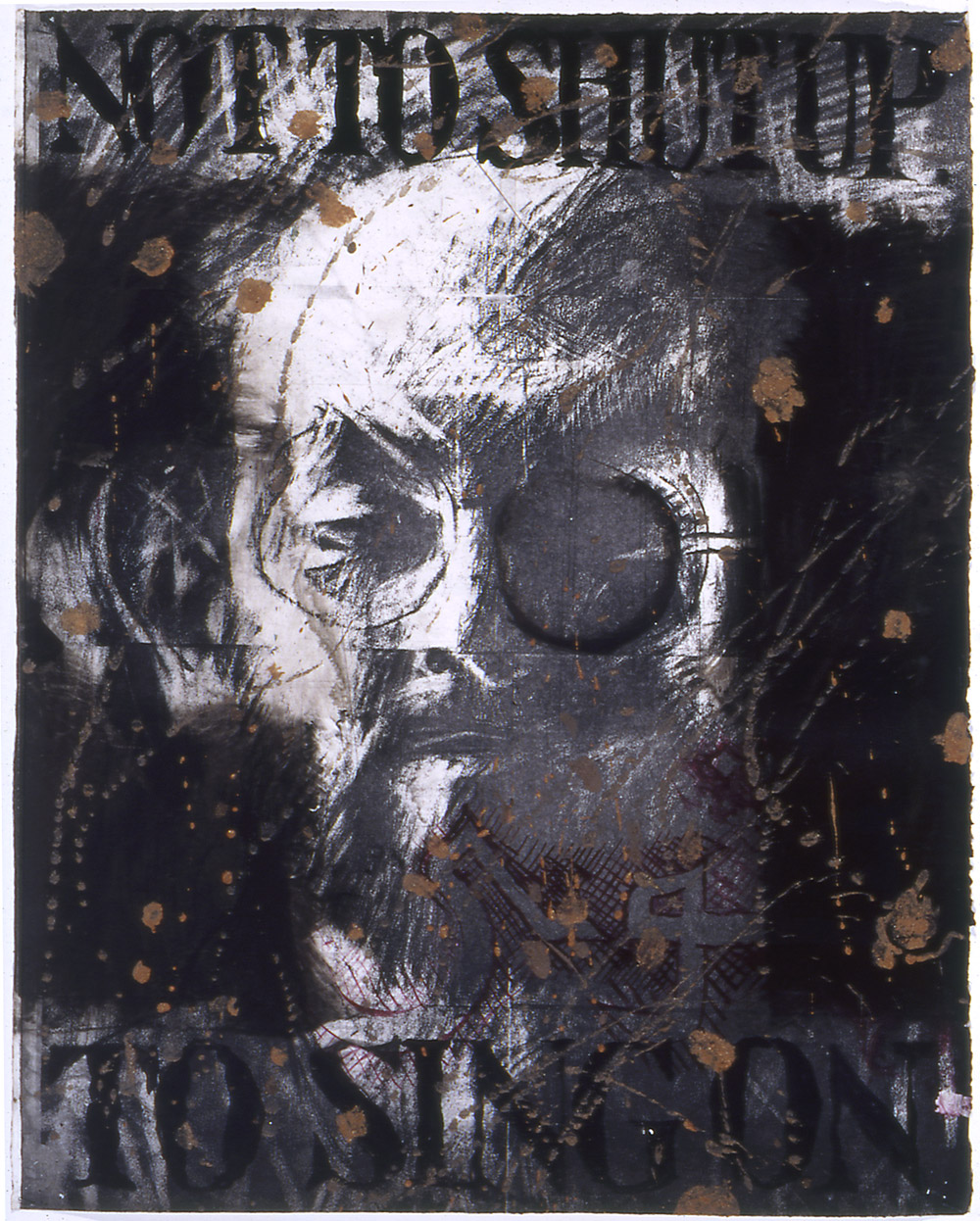
Tom Phillips 'Salman Rushdie' (probably 1993) Charcoal, red and black body colours,
 brown mud bound in liquitex mat medium on white paper.
 
Most exhibitions I visit are intentional, in the sense that I plan to go see them. Visiting ‘Great British Drawings’ was more fortuitous in that I went to see it simply because I had some time to spare!  In that respect it was a pleasant surprise with equally a few seldom-seen gems amongst the collection on display. These include a Tom Phillips charcoal, mud and liquitex drawing of Salman Rushdie, (pictured above) which was uncannily Jim Dine like in its drawing style through heavy use of black and intense mark-making. Elsewhere it was refreshing to see a pen and ink drawing by Edward Coley Burne-Jones (of Pre-Raphaelite fame) that was in its small, more intimate scale more engaging and visually interesting in tone/marks than any of his paintings in my opinion. A few more of the Pre-Raphaelite ‘gang’ had work displayed in this exhibition and whilst I wouldn’t say I’m a fan of work from that period the difference in a perceived sense of warmth between their drawings and their paintings was quite striking. It reaffirmed that the pre-emptive nature of drawing, in the way it was used often before or as a way of composing a painting is so much more revealing of the artists hand and first impression of what they are looking at often than the painting. The painting is more measured in that it has been considered, edited and planned to convey what the artist ‘wants you to see’ whereas a drawing can be as considered but is often more ‘of the moment’ and sort-of as consequence, I feel, slightly more real (‘real’ in the integrity sense of the word rather than necessarily ‘realistic’) Turner is however a good exception to this theory whose drawings are also in this exhibition, he paints very much how he draws and the drawings inform the painting as much as the drawing is informed by the materials he is using.  Again, it was great to see these smaller on paper watercolours which if anything felt slightly fresher and less laboured than some of his paintings.
 
Samuel Palmer 'The valley with a bright cloud' (1825) Pen and dark brown ink with
sepia mixed with gum Arabic, varnished.
 
Edward Lear 'Contstantinople from Eyoub' (1848) Pen and brown ink
with watercolour over graphite on wove paper.
 
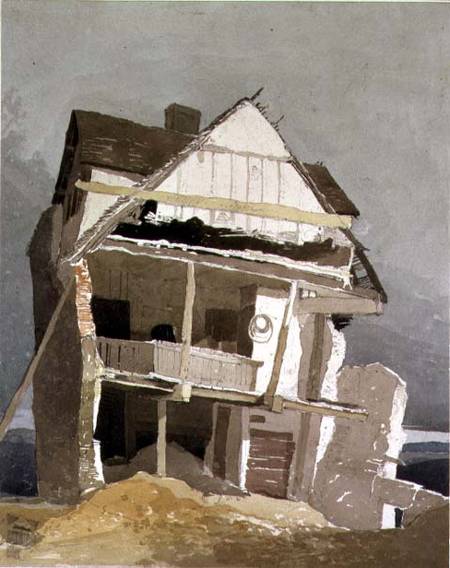
Flavour of the month, Eric Ravilious also had a drawing present in this exhibition along with Samuel Palmer (pictured above) who feels vaguely similar in that both were attempting to depict the romanticism of the English landscape, the undulating hills, cloudy skies, ploughed furrows in fields, rows of corn, hidden pathways, stone walls and all the variety in textures of trees, leaves, hedges and fauna. I also admired the draughtsmanship of artists such as Edward Lear whose illustrations I was familiar with but until now had never seen these more technical drawings (pictured above) which although preparatory for something finished are still quite elegantly sensitive and informative in their own right.  There was also work that reminded me of the importance of drawing as capturing an impression of something and the immediacy and observational sketchiness of John Sell Cotman’s ‘A Ruined House’ (pictured below) being one example and also a more unusual contrast to the familiar subject matter predominantly limited to classical architecture or castles (though many of these perhaps also united to this drawing in being ruins but of a slightly different nature).
 
John Sell Cotman 'A Runined House' (1807) Watercolour over graphite on paper.
 
This was a quietly contemplative exhibition, with lots of looking and noticing attention to detail of the kind which drawing tends to invite more gently than painting so whilst the Ashmolean probably possess infinitely more work they could have possibly shown in the space it still felt as though there was a lot to see. Certainly a lot to think about.
 
‘Great British Drawings’ is on at the Ashmolean, Oxford until August 31st.
 
*Taken from  CRAIG-MARTIN, M; ‘On being an artist’ (2015) Art Books Publishing: London. p8.