Showing posts with label Channel Four. Show all posts

Monday, 16 October 2017

Everything to Everyone

“I’ve renamed it the Most Popular Exhibition Ever except for Banksy.” -Grayson Perry

On a central street in Bristol a group of people are participating in a ceramics class at Potstop Pottery. The time is around 8pm, I am passing by, the glow from the window and movement of activity inside catches my attention. It looks busy, there are lots of pots and ceramics in the window on display, people in the background making were the things I noticed, without lingering other than to take a quick photo of the name of the place on my phone. It looked fun, understated and genuine; for reasons that will soon become clear, it felt poignant given from where I had been a few minutes earlier. A hundred yards away I had just emerged from the crowds of people who were still waiting in a queue that is still four-people deep outside the Arnolfini, all waiting their turn, as I had, to enter the self-prophetically titled, ‘Most Popular Exhibition Ever!’ from artist turned celebrity, Grayson Perry. Only in retrospect, as I now walked past this real-life pottery lesson taking place before my very art weary eyes did I truly appreciate the irony of queueing to see ceramics displaying ‘British-ness’ when the real thing was happening in a slightly different form a matter of metres away.

In the artist’s own words, “Art quickly becomes less attractive when you have to queue to have a glimpse of it.” I thought, “You’re telling me!” I often found myself asking ‘why’ as I amongst the first wave of the public was funnelled on mass into the familiar atrium of the Arnolfini, more thrumming with bodies than I have ever seen before. Queueing does however add to the sense of anticipation and viewing amongst the masses a ‘shared-experience’. The fabled exhibition on its first UK stop tour from The Serpentine in London, is presented at Arnolfini across three floors; featuring ceramics amongst other things tapestries, woodcut prints, bronze sculptures and maybe on the 26th of September, just possibly a glimpse of the man himself!  All of whom probably most people attending had previously seen on various television programmes Perry had hosted on Channel Four. Nonetheless there we all were! Without such publicity that could have ever imagined that we’d be so excited about an exhibition of ceramics at the Arnolfini? Are we there to see ceramics or are we there for the moment? How much of that interest and enthusiasm has since transferred itself back into an interest and engagement with making and the arts? Were the people visiting Perry’s exhibition interested in Potstop Pottery or perhaps vice versa and either way did it matter?...

“Popularity”, Perry denotes, “is a serious business.” Whose ambition for the exhibition is to, “Widen audience for art without dumbing it down.” It is a difficult aim to fulfil. When so much of an art gallery’s funding is dependant on visitor numbers there is the temptation to fill these spaces with art that is accessible, fun or as is the case being explored here, ‘popular’. The theory of how galleries are currently justified, as Perry himself explains as,

“There are two metrics that hold weight in the art world. One is auction price: how much in cold cash someone is prepared to pay for a particular piece by a particular artist. The other is visitor figures -how many people go to see certain exhibitions…Visitor numbers are in a way another empirical measure of quality.”

This raises several debates but particularly on how museums and galleries programme their exhibitions and whether measuring success and quality based on popularity is as hard to define as it is potentially troublesome. However, I have never looked at the reasons why people visit or not art galleries and can only assume that those entrusted with the precarious task of filling these spaces programme exhibitions based on a balance and not fall into labels of marketing whereby an exhibition is popular as to another that be deemed challenging. Most exhibitions fall into multiple if not hazy realms of categorisation. I do not have the answers and neither does Grayson Perry it seems, but what I do admire him for is his ability to articulate issues within the arts and put forward questions and issues that we should think about, if not challenge because he seems for an appreciation of art that is not passive even if it is 'popular'.

For an artist that continues to explore both his own and the nation’s identity, Perry has either unwittingly or cleverly almost marketed himself as his transgender alter-ego, Clare; or the man in the dress that makes pots. These identities that were once part of the challenging and exploration of what Grayson Perry’s art is about [identity, perception, surfaces] have since become ‘accepted’ and familiar so it becomes an interesting contrast and dilemma of what happens when the outsider is no longer outside?! My friend gave the analogy of anti-establishment American punk band Green Day becoming so popular that, that they aren’t quite punk anymore. Maybe in being popular, Perry and Green Day can reach a wider audience with the brand of unconformity or rebellion that they are selling, but on the negative side, maybe it also gets diluted and becomes acceptably-edgy rather than maintaining its power to cause affect through shock. This sentiment best echoed in the context of having this exhibition in Bristol as its first place to be shown outside of London is telling of the city’s relationship with graffiti art and the similar dichotomy of the ‘political made popular’ with work made by Banksy whose exhibitions at Weston’s Tropicana and Bristol Museum were arguably, at least in terms of visitor numbers, amongst the most popular exhibitions in the area in the last decade!
 
'Kenilworth AM1' 2010 Custom-built motorcycle
An exhibition with this amount of hype comes with a huge amount of expectation and we are welcomed on the first floor with works which explore, ‘what makes a man’. A tapestry made in response to the ceremony of the blessing of the banners with Durham Miners as part of a Channel Four programme on different social-class tribes, traditions and how these factors shape a sense of communal identity. It also includes Perry’s custom-made motorcycle in pink and blue with its own Popemobile style box for Alan Measles (his teddy bear). The symbolism of what masculinity is thrown away from perceived stereotypes with the inclusion of words such as, humility, patience and chastity. In the upstairs galleries the theme of identity continues with an exploration of ‘Britishness’ and the ‘tribes’ of Britain exploring the impact of Brexit amongst other social and political issues. I would speculate that one of the reasons that this exhibition and Grayson Perry are so popular is because he makes art that engages and is interested in people and what they have to say. Who doesn’t want to be listened to? A huge positive that both the public and people in power should draw from Perry’s work, is the benefit of integrating arts more into society as a way of engaging discussion and providing a voice on issues in a way that has a high profile but allows people to express their views more openly because it does not conform with the usual systems of government.

'Death of a Working Hero' 2016 Tapestry
'King of Nowhere' 2015 Cast iron and mixed media
I am conscious that I have written little on the actual work and content of this exhibition, as there is a LOT in it, but I feel somewhat fatigued with seeing these works again; their message already written or spoken much about on their corresponding televised documentaries. One pot represents the Brexit voters the other the remainers; both unremarkably similar. I am now more interested in the phenomenon of the show as a whole, why it is popular and what implications, opportunities or indeed threats does that place to art, artists, the public and galleries etc. For example, I would be interested in Grayson Perry using his ‘celebrity’ to empower people as an artist to make their own art/images/pots in response to the issues he raises rather than documenting them as is the formula he has begun to adopt.     

I have a problem with the idea of ‘art for everyone’ (said the girl who writes blog posts so that others may be inspired to see or understand art work differently....) Maybe I am ignorant, but I am supposedly part of the ‘art world’ having studied it and there are huge swathes of art past and present, I don’t understand or that makes me feel uncomfortable. If compelled, some of it I attempt to figure out and may be rewarded by my puzzle-solving abilities... And sometimes, for a variety of reasons too numerous to mention here, I cannot be bothered! It should be enough not to have to like it all but also to give everything a try before you dismiss it and know why you do not like something. The catalogue for the exhibition states that,
 
‘He [Perry] thinks art shouldn’t be an exclusive club for people who ‘get’ it, but for everyone…’
 
The problem with trying to do something that is popular or appeals to everyone is that in trying to be everything to everyone the result ends up ultimately, being about nothing. Who is 'everyone' anyway? I think we are all so different that it is almost impossible (surely) to make work that appeals to all. Art work and curation of galleries should never panda to a market-driven sense of taste or inclusiveness, quite the opposite; they should feel more empowered to create new discussions, trends, topics. As another analogy; I enjoy visiting museums and looking at entomology collections and dinosaur skeletons, it doesn’t mean I know or even need to know much or anything about them in order to appreciate them. My reasons for visiting are driven out of curiosity, something to do and experience, wanting to learn or be challenged. Our relationship with art and art galleries is always so much more confrontational and met with a different set of expectations different but irrespective of everyone’s personal experience. I think that educationally we do need to do more to teach how to read visual language and not just how to make it and galleries need to take their own responsibility at always adapting to get better at inspiring, promoting, enthusing, articulating and creating reasons why people should go and see/experience art. Easier said than done!  
 
'Battle of Britain' 2017 Tapestry 302.7 x 701cm.
As I leave the crowds I wonder, how memorable individual works in this exhibition will be in twenty, fifty, a hundred years time? In what way will we be talking about them and how does this compare to works that were deemed ‘unpopular’ in their own time and have since become significantly valued or culturally important? The saving feature of Perry’s work is that the production and craft that goes into producing them has a hand-made sense of integrity that will ensure their preservation in stopping these pieces becoming quick one-liners. Though I feel that the increasing appeal is not through what Perry makes but what he says, writes and his interaction with the people who visit galleries (or not) and the institutions of art itself [the gallery, the art school, the museum etc.]. These are good conversations to be happening and I can only hope they act as a spring-board or catalyst for change in people’s aversion to viewing art or going to galleries or galleries/museums to take more risks with what they show, promoting a diversity between the ‘popular’, the ‘outsider’ the new, the old, the controversial, the cerebral, the political, the visual and everything in-between. It is a big ask and comes with high expectations on both sides, but the Arnolfini has the perfect opportunity at the moment as it asks audiences to rewrite its ‘rules’ for its continued ethos going forward [see https://www.arnolfini.org.uk/whatson/new-rules].

In light of the current exhibition the rule I would suggest is; 
You cannot please everyone but everyone wants to be pleased.
Or in other words, do not be afraid to show work that people may not like or understand, that is challenging or uncomfortable but assume that everyone who does visit you is there because they want to engage and to have a meaningful experience, so try and give it to them!

Contribute to the hype and Arnolfini's visitor numbers as your feet can help fund more shows by visiting 'The Most Popular Exhibition Ever!' open TUES-SUN 11.00-18.00 until Christmas Eve! https://www.arnolfini.org.uk/whatson/the-most-popular-art-exhibition-ever-grayson-perry

Friday, 7 November 2014

Turner Prize in your eyes!

There is a lot of carpet flooring in this year’s Turner Prize which could also be something to do with three of the four selected artists being film based [carpet, of course dampening the distracting sound of footsteps]. It took me longer than I’d probably like to admit to arrive at that conclusion spending my first Turner Prize 2014 moments adjusting to the dark, sound proofed interior of the exhibition space at Tate Britain. The 2014 prize marking my third overall Turner Prize viewed, the first artist/work of which I’m confronted by in the year's show was James Richards's film, ‘Rosebud’ displayed on what is possibly the biggest free standing television monitor I’ve ever seen! I sit down next to my fellow Turner Prize goers, a middle-aged woman (or so I assume!) and a young mum and toddler, wondering if they are full of the same heightened sense of expectation and intrigue as me. A minute later and the middle-aged woman begins administering herself eye-drops, much to my bemusement, a darkened art gallery being a fairly impractical place to start dispensing eye-care, surely? But needs must and I speculated if maybe there was something in her eye medicine that made her see everything a little differently or maybe she was preparing or purifying her eyes in anticipation for what she was about to see...? Perhaps I should have asked to borrow some? Should eye-baths be dispensed at the beginning of all art exhibitions? Sadly, though I did not know it at the time, this amusing encounter was to be one of the few lasting images I took away from this year’s prize. 

Sigh.
 
Now in its 31st year the 2014 Turner Prize features the work of four artists, ‘under the age of fifty, born, living or working in Britain, for an outstanding exhibition or other presentation of their work in the twelve months before April 2014’.  This year’s nominees include; Duncan Campbell, Ciara Phillips, James Richards and Tris Vonna-Michell. On Monday 1st December one of these four artists will be chosen to win the £25,000 prize by a ‘jury’ of art curators from this country and abroad. Locals may note one of them being the Director of Bristol’s ‘Spike Island’, Helen Legg.

Rather depressingly this year’s Turner Prize is dominated by film. And ironically, after an earlier post about my inhibitions to watching film in art galleries generally*, I now found myself in a situation where I have to watch three all at once! Debatably previous Turner Prize’s may have been too accommodating, or trying to be inclusive for short-listing artists across different mediums each year (painting, sculpture, film and in more recent years performance art being represented) but I find it somewhat sad that there isn’t at least one painter, sculptor amongst the group and don’t feel the decision of so many film artists nominated this year is reflective of a decline in the quality or abundance of artists who categorise themselves as painters, sculptors etc. In fact, the Turner Prize felt like something of an anticlimax after having to navigate one’s way through the breathtaking scale of the Phyllida Barlow's installation of ‘stuff’ in the Duveen Galleries. Surely she deserves to be nominated one year?

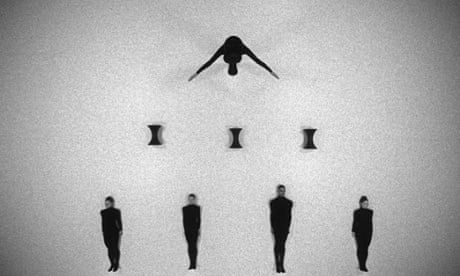
Still, the Turner Prize has always been renowned for its notoriety, its controversy and its general challenging, at times awkward relationship with both the public, the media and the art world alike. In defence of this year’s chosen four, when you go into the work in more detail, one begins to realise it is perhaps the labelling of ‘film art’ that becomes irrelevant and blurred as each artist uses the medium differently. Stills from Duncan Campbell’s ‘It for Others’, in the form of a choreography of dancers dressed in black, becomes sculptural, James Richards produces accompanying tapestries to his film and Triz Vonna-Michell’s work feels more like a museum/performance poetry than to be labelled just as ‘film’. Most frustratingly of all however, despite their differences, it is still really hard to pick a winner amongst the four. I don’t personally feel one artist stands out much above the rest, making the question surrounding the Turner Prize this year not really a matter of who will win but should we really bothered?

James Richards 'Rosebud' (2013)

Before I was easily distracted by eye-drops, I was watching James Richards’s film ‘Rosebud’, a fragmented collage of personal archive footage or as Richards explains, ‘a restricted set of image sensations’ that flicks between grainy images of roadside shrubbery, pornographic  images from a Japanes art library which have been censored by the scratching/sandpapering away of the genitalia and close-up marco shots of President Hamilton’s eye on a ten dollar bill, its surface looking more like tattooed skin than paper. It moves (or is edited), with what’s been described as a ‘claustrophobic intensity’ whereby the ‘bigger picture’ is never shown; the viewer subjected to incredibly close-up shots, glimpses in a sort-of post-modern peep show. The soundtrack, coming from Richards’s background in experimental sound production is a series of amplifies noises of scratches and high pitched whistles and at this point I stopped trying to make sense of what I was seeing, what it all may mean and/or how it related to one another and instead focused on what it made me feel, which I guess was slightly unnerved. The whole thing was oddly tactile, in parts violent in others sensual; the textures and sounds present making it a ‘felt’ experience’ as to just being something you saw with your eyes. A quote I read from Richards goes some wayto articulating my own experience, ‘the screen is less a window into another world...but rather a surface upon which sensorial information can pass.’

Ciara Phillips 'Things Shared' (2014)
 
 Another collagist of sorts and who is the only artist not to use film is also this year’s only female artist; Ciara Phillips, creates silkscreen prints from imagery started from accidental ink splotches which have then been enlarged, cropped and repeated into a bigger ‘collage’ come installation. In the Turner Prize show ‘Things shared’ these prints have been pasted directly onto the gallery walls, the letters, K, N and O singled out and presented in the work in seemingly random intervals, of which Phillips implies, ‘I prefer letters to words –words can be a limit on meaning, but letters give their voice to other languages present in the work.’ In another aspect to this space a sound piece in a booth plays conversations recorded with the practitioners she collaborated with to make the prints as they share their experiences of process/making.  I think the work presented by Phillips in the Turner Prize highlights the danger of seeing just one body of work from these artists, usually out of context from the larger body of work within which it sits. I struggled to get much from this work seeing it alone, but having read more on the artist since, I think some of her concepts on printmaking as a process to ‘im-press’ and the double meaning surrounding the word are actually quite interesting. It is a shame I didn’t get it from the piece exhibited at the Tate.
 
Tris Vonna-Michell 'Postscript II (Berlin)' (2013)

Tris Vonna-Michell may at first appear to be as I so rudely put it, ‘another film maker’ however he is also a historian of memory and uses his own personal life history and relics from his past to self-destruct, interpret, copy and create new stories/identities. Using slides, photocopies, found images and historical references Vonna-Michell creates new narratives and storylines based on the opposing images projected. In addition to the images Vonna-Michell records or performs a live monologue influenced by the sound poetry of Henri Chopin (whom he sites in a specific piece of work, ‘Finding Chopin: Dans l’Essex’) scrambling through his memories, repeating words and phrases. Dotted between these works are the paraphernalia of his source material, photographs, slide projector boxes, shredded paper, designer chairs becoming an archive in addition to the story. The viewer unwittingly also becomes part of unravelling the mystery and trying to make sense of it all, so much so you are left wondering how much is real and how much has been fabricated, how much is a copy. This layering and uncertainty, borrowing and altering, though fabricated is, I found, a more accurate representation of ‘a life’, ‘an identity’ than that of trying to tell or document it accurately. What Vonna-Michell’s work shows is that identity and personal narrative is made from multiple encounters, sources; meetings with other people and their life stories, fragments from the self we project and show to others and the self we perhaps are in private –the whole thing is very layered and is not a linear form of storytelling. Out of all this year’s nominated artists I personally found his work the most engaging in the sense it was made from lots of different components which forced you to participate and think about your own narrative/storytelling.
 
Duncan Campbell 'It for Others' (2013)

The last artist in this year’s prize is Duncan Campbell, already tipped by critics as the favourite to win, he presents two films ‘Stills from Sigmar’ a digital/stop-motion animation hybrid and ‘It for Others’, another hybrid that blurs the lines between documentary film-making, re-enactment and disjointed fictional/non-fictional narratives. ‘It for Others’ is a response to Chris Marker and Alain Resnais's 1953 film ‘Statues Also Die’ a film that explored the commercialisation of African Art. It argues that African Art out of context loses its original function and ‘degenerates to commercialised decoration’. A point that becomes increasingly awkward and provocative when in relation to African art in museums and art galleries (the piece narrated over images of African masks and objects). In another part of the same film a dancers appear to trace words/symbols from Karl Marx’s ‘Capital Volume I’. Sadly, I don't think these ideas being communicated through choreography are any more accessible than they are being read. Through several different visual displays Campbell weaves together a thought-provoking comment on commercialisation although arguably it represents rather than contributes much, if anything new to the debate that hasn't already been done. And by this point, as the last artist in my Turner Prize journey, unfortunately for Campbell, I was beginning to lose energy. Campbell is probably the most accomplished 'film maker' of the three, his editing, storytelling and shots being the most cinematic but I am unconvinced that that is enough to win.
 
This year’s Turner Prize was difficult! The work demanded a lot of time in order to be understood and out of context from the artists other work I felt there was much I was missing or failing to grasp. Was it worth the effort? I don’t honestly feel it was. There have been many, many more artists who’ve been interesting this year outside the realms of the Turner Prize, Phyllida Barlow, Tania Kovats, David Batchelor to name a few. If I had to pick a winner, Tris Vonna-Michell would be my bet simply because his work best emulated the thing I found most interesting in this year’s Prize, which wasn’t the work, but the lady putting in her eyedrops.  The mundane honesty of, ‘So what if I’m in an art gallery, my eyes are killing me. Time for some eye drops!’ was more amusing, more lasting and more realistic than anything much I saw in the Prize itself. Whether Vonna-Michell’s narratives are ‘real’ or not I guess it felt the most human of all the work presented this year and for that relatable quality his work provides where the others tend to alienate, he deserves to win.
 
  You decide? -The Turner Prize 2014 can be seen at Tate Britain until 4th January 2015

 Winner announced on Channel Four, Monday 1st December, time TBC.


Images from: