Showing posts with label Gabriel Orozco. Show all posts

Monday, 16 January 2017

Fantastic Artists and Where to Find Them

Upstairs Gallery -'Animality' at Marian Goodman Galley
As one steps inside the familiar white-walled terrain of the contemporary art gallery one is greeted by the shrieking caw of ‘GilbertandGeorge!’ 'CyTwombly!' 'CarlAndre!' and names of other artists in a sound piece titled ‘Birdcalls’ by Louise Lawler [1972]. Above me there is a stuffed magpie, to the right a giant photo of an elephant and ahead a portrait of a tiger looks straight at me between an oversized stuffed squirrel, rows of glass vitrines, plinths and free standing sculptures. These are animals but not as we are accustomed to; myths and conventions around how we perceive animals are challenged in fun and unexpected ways across two floors in a menagerie of film, photography, sculpture and illustration.
 
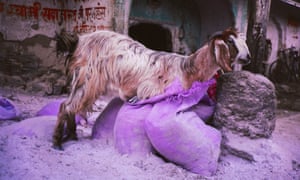
Gabriel Orozco 'Goat in Purple Bag' 1996
"Animality quietly crept up on me and completely took me by surprise. It was without doubt one of the most exciting exhibitions I saw during 2016, on for just over four weeks in November-December at the London Marian Goodman Gallery in Soho."
 
Imagine the best of the science and unusual curiosities of a Wellcome Collection exhibition mixed with works by modern and contemporary artists and you’ll have a good idea of what made this exhibition so special. ‘Animality’ featured the work of over seventy ‘creatures’ comprising of artists, philosophers, writers, scientists and illustrators throughout history (Darwin, Heidegger, Foucault are here and more) seeking to understand the complex relationship humans have with animals; what it means to be human, what it means to be an animal and how the division between the two is sometimes not as distant (if at all) as we thought. What works so well within this exhibition (and other exhibitions I have seen of this type) is this fusion between science, history and philosophy either integrated with art works or presented in context alongside them. This is science and history at its most engaging, its most visual and, I think, is significantly longer lasting in memory for it.
 
Albrecht Durer 'The Rhinoceros' 1515
 From the graphic illustrations of Charley Harper to the observed biological illustrations of Earnst Haeckel and woodcut of an armour plated Rhinoceros by Albrecht Durer (pic), ‘Animality’ covers a breadth of ways in which humans have not only sought to represent animals in art but in doing so were also attempting to understand and educate themselves and others in outcomes that are in some cases playful and in others personal or documentarian. They each offer insight into either our fear or love of beasts, bugs and creatures of all shapes and sizes; those that can eat us, others be eaten. There is a whole Zoo here, tigers, elephants, cats, slugs, horses, magpies, goats and camels including mythical creatures and hybrids throughout history. Despite being a mixed 'museum meets art' exhibition there is no hierarchy of one depiction of ‘animality’ being more significant than any other which is what makes it particularly rewarding, both the scientific and historical are presented alongside the whimsical and fun, grouped together into themes of origins, markings, crossings, variations, trace and extinction.
 
Roni Horn 'Untitled no. 4' 1998
Roni Horn’s photos featuring the backs of bird’s heads (pic) are surprisingly confrontational and unfamiliar, unsurprising  as it is an angle we are not accustomed to seeing birds being taken at. Similarly unsettling is Sarah Jones’s ‘Black Horse’ is striking not only in its scale but in its black on black image of a horse that almost disappears and reappears so we are forced to look at the catches of light on the muscles that define the form of the body. Elsewhere another horse piece by Steve McQueen, ‘Running Thunder’ depicts a horse that at first appears to be asleep in a grassy meadow, the scene a relatively still one until we see a fly pitch around its eyes and we make the startling discovery that this horse is in-fact dead. It is more a comment on our relationship with how we perceive and ‘expect’ to see animals in art; here the expectation of the horse as heroic or symbol of wealth as familiar in paintings by George Stubbs is given a dark twist. A goat stands inside a purple bag (pic) in one of a series of photos by Gabriel Orozco but is more photography than it is fitting in ‘nature photography’ as they do not attempt to present an ideal as much as a reality. Danh Vo reminds us of history in presenting a photo of a pekingese on a throne, the dog once belonging to Queen Victoria plundered from Beijing by British troops during the second opium war.
 
Carsten Holler 'Octopus' 2014 
Amidst this Noah’s Ark-like procession of animals Carsten Holler’s pink octopus (pic) creeps along the gallery floor adding an element of unexpected fun to the proceedings, making us aware of the space in which we inhabit together; like many of the works in this exhibition on its own it doesn’t have a huge amount to say but as part of the whole they form a welcome visual rest bite. Over by the stairs Fischli and Weiss’s projection of a cat lapping up cream plays on continuous loop which is fun if nothing for its almost banal familiarity. There is an almost absurd amount of work to process which only compounds why animals as a subject matter in art is so diverse and why even early George Shira photography first published in National Geographic in 1906 being shown alongside contemporary art works does prove that photography and art are still relevant in aiding education, research and conservation. Seeing Pavia and Gusmao’s slow-motion film of a peacock strutting should be a relatively familiar sight to anyone who’s ever been to a zoo or heritage garden but this film acts as a reminder, as though you were seeing them for the first time, to just how strange, marvellous and remarkable a bird they really are. Or if anything the works in this exhibition only highlight that the real mystery and most complex creature of all is in-fact the artist. Intellectually challenged I proceeded to scramble on two legs out the gallery door and into the jungle outside....
 
Roni Horn and Gabriel Orozco images Sourced from:  http://www.tate.org.uk; https://www.theguardian.com

Monday, 16 November 2015

Conscientious Anarchy

It was only a few months ago that we were all queuing for Banky’s Dismaland in Weston to experience the anarchic spectacle as the artist unabashedly stuck the proverbial finger up at consumerist Capitalism and modern British political system. Now we find ourselves queuing again for Ai Weiwei at the Royal Academy, London for the largest exhibition of the Chinese artist’s work in the UK to date. Whilst both are subversively political, challenge established ideas, question the cultural/financial values of art and are hugely successful at drawing the crowds there are still many things that separate them as unite them. I wonder though how many people will have seen both?
 
Weiwei’s art is anarchism that has found a conscience. If it’s possible for the two to work harmoniously together then Weiwei achieves it, in what are often very minimalist, conceptual and highly labour-intensive, ambitious sculptures/installations which subversively challenge human rights  in previously untold or censored narratives of events. It is highly emotive work and charged with the ongoing ethical battle ‘freedom of speech’ that has even seen the artist who was commissioned with designing Bejing’s Olympic Stadium and conversely also imprisoned by the state. Renowned Blogger and art activist, Ai Weiwei’s exhibition at the Royal Academy creates an interesting tension between the popularity of activism in 21st Century Britain and place within which political artworks sit within the institute of the art world.

Two open copies of Phaidon’s iconic ‘The Art Book’ (the A to Z of ‘significant’ artists from medieval times to the present day) lay open side by side. The English/American version features Ai Weiwei and the Chinese version does not. In omitting the existence of the artist in one but not the other probably does Weiwei’s notoriety more good than harm but also somewhat chillingly summarises what is the principle themes in Weiwei’s practice of control, censorship and the documentation of history.
 
'Straight' (2008-12) Steel reinforcing bars, 1200 x 600cm. 
If the meaning in Banksy’s work is a one-liner then Weiwei’s is a poem. Ideas and meaning unfold gradually and are open to many interpretations. In the installation, titled ‘Straight’, 200 tonnes of steel reinforcing bars lay in undulating rows atop one another creating a wave on the floor of the central exhibition space. It first reads as a work of minimalist sculpture. Whilst it is massively ambitious in scale it’s simplistic in design; made up of one essential material lain in a systematic, regimented form. The whole thing takes on new significance when you discover the detail and making behind the work (and I stress that the only real way to do this is with the exhibition’s accompanying free audio guide) that the bars are from buildings involved in the Sichuan earthquake in 2008 which have each individually been straightened by hand from their post quake twisted state. The waves in which the bars have been arranged now become shifting tectonic plates or waves off a Richter scale; each of the bars becomes symbolic of the scale of destruction and somehow quantitative to the number of lives lost. Even more worrisome upon the final discovery that the steel bars were taken from twenty schools whose construction was covered up by the Chinese government who after a forced investigation instigated by Ai they had to admit that corruption allowed builders to ignore safety codes when erecting the schools. Over 90,000 people were dead or missing as a result of the quake and it wasn’t until further investigation using social media and Ai’s blog that the names of the 5192 children who perished were published and in the exhibition accompanies the work ‘Straight’ surrounding it on the gallery walls.
 
[detail] 'Straight'
Ai Weiwei’s work is known for its use of traditional craftsmanship skills, influenced from Ai’s upbringing when the artist initially earned money fixing/making furniture. In the pieces in this exhibition such as ‘Straight’ the work utilises the power of many and communities who collected and reshaped the steel bars as well as assisting in the collection of data and names of those missing/deceased to be revealed. It is an empowering piece, the fact the bars have been re-straightened is in itself an act of defiance and resilience, an attempt to correct that which is broken. The architectural properties of the bars as well references not only Weiwei’s own relationship with buildings as an artist that has worked as an architect but alludes to the idea of architecture as a way of reinforcing control on people, upholding certain regimes or influencing behaviour. It is a theme which reoccurs in many other works in the exhibition, ‘Souvenir from Shanghai’ being an arrangement of brick, stone and rubble from the site of the artist’s studio which was built with permission from the Chinese authorities and subsequently ordered to be knocked down within weeks of its completion after relationships with the authorities and Weiwei had soured after the artist’s arrest and detainment in 2008. The authorities continue to survey and monitor Weiwei’s activities since.
 
For me, Weiwei is an important artist because he is one of a few contemporary artists working today that raises the importance and position of art in modern life and the power of artists within society. This is a concept which has been maintained by Weiwei in his blog and twitter feeds which the artist sees as an integral part of his artistic practice into the modern wider world. The role of the artist becomes a duty or obligation to the wider community or audience (but does not necessarily mean it has to lose its playfulness or questioning nature). It reminds me of other artists who similarly work within their communities/political systems such as, Gabriel Orozco, Mona Hatoum and Francis Alys.
 
'Dropping a Han Dynasty Urn' (1995) Triptych of black and white prints, 199.9 x 180cm 
Throughout history you had your Duchamps, Warhols and Rauschenbergs who somewhat arrogantly or playfully (depending on how you look at it) called anything that they signed, said, exhibited or mass produced; ‘art’ . They re-valued and reassigned what art could be and what the role of the artist was. Weiwei has stated being influenced by these artists in his own earlier works and in this exhibition presenting the piece, ‘Hanging Man’ made from a bent clothes hanger as a direct reference to Duchamp and Dada. Given a similar treatment are ‘Table and Pillar’, one of a series of works that explores combining two ready-mades from Qing Dynasty temples to create new forms and challenge the ‘value’ of history vs. the art object; ‘Dropping a Han Dynasty Urn’ and Weiwei’s coloured/Coca-Cola vases, again in which the values of cultural and financial work are questioned as well as the challenging of history, systems which it is documented/recorded and whom in society has the power to assign value to an object. The latter is an ideology is echoed in the beginning example of Weiwei’s omission from the Chinese Phaidon ‘Art Book’ to which Weiwei states a defiant truth, ‘The art always wins. Anything can happen to me, but the art will stay.’ Alternatively Weiwei’s intervention of historical artefacts is seen to some as a deliberate act of vandalism, but perhaps in a similar way to Banksy, the role of the vandal and the artist are subverted when both artists’ interventions often add a commercial and cultural value to an object? As well as questioning the nature of what vandalism is it empowers the makers as being in control of creating value to objects rather than being dictated by authorities or system within which the work operates.

[detail] 'Forever Bicycles' (2009-14)
At times all of this becomes a little heavy and one almost feels better not knowing of the injustice, corruption and atrocities. Ignorance becomes bliss, but I still acknowledge that they are truths that we should and cannot ignore. “Art is not supposed to repeat what you already know. It is supposed to ask questions.”* The show ends on a slightly more light-hearted note with the recently commissioned piece specifically adapted for the exhibition, ‘Forever Bicycles’, a chandelier  made up of Chinese bikes strewn with crystals  hanging from the domed ceiling. The idea of a journey, wheels in motion and circular routes in some ways mirrors the artist’s new found freedom of having his passport reendowed since it was taken from him by the government in2011. It ironically also raises the ethics of being an artist as whilst Weiwei is an ambassador for freedom of speech it could be viewed that in his chosen occupation he has to lose his own freedom in his commitment/celebrity-like status to his cause, “an artist is never free...an artist is bound by his gift, his vocation”**
 
Weiwei has more than once stated his belief that it is not possible to separate the art from politics in China and goes back to my own belief from earlier that he is an anarchist with a conscience, an artist who sees his role as not merely a matter of presenting the world but fundamentally trying to change it. 

 
Ai Weiwei is on at the Royal Academy until December 13th 2015
 
 
All text and images Copyright of Natalie Parsley©
*Kutlug Ataman from ’33 Artists In 3 Acts’ Sarah Thornton
** Andrei Tarkovsky ‘Sculpting in Time’

Friday, 29 November 2013

Controller of the Universe


 Flicking through the 2013 Venice Biennale catalogue I came across this, 'Controller of the Universe' by Damian Ortega. Unfortunately this work didn't actually feature in this year's Biennale, an outdoor landscaped, site-specific piece called 'Communications System' was exhibited instead. So despite not coming across any of the artist's works in Venice I'm still very excited to discover the specific piece of work pictured above and wanted to briefly give it a mention. It reminds me of Cornelia Parker's exploded shed but with tools! 'Controller of the Universe', (taking the title for the moment out of the mix and looking at the work visually) makes me think about the 'Big Bang' which gives birth to a string of associations leading from the Big Bang, creation of the world/mankind to man's origins through tool use, making, evolution, production, industry etc. etc. And without having actually experienced/seen the work I'd hazard a guess that it has a feeling of being sort-of playfully amusing but also slightly threatening in the sense that the tools are 'coming out at you' in an explosion. If I include the title, I'd probably question who is the 'controller' referred to in the title, is it us, the makers of tools? Did we create this explosion (which could act as a scene of both creation and/or destruction)? Who wields the tools in society and are they the ones in control (and what is it they are in control of?) And is the person who uses the tools often the person in control? Suddenly it all feels as though it could begin to get very political. Maybe that's what Ortega intended?   

Described as a de-assemblage artist, Ortega creates suspended sculptures using everyday /found objects from pick-axes to bricks and tortillas. Sometimes he deconstructs the objects to expose their inner components, as he did with his 2003 entry to the Biennale, taking apart and reassembling a suspended Volkswagen Beetle. The resulting work looked a bit like an Air-fix kit or mechanic's manual and offered a new way of seeing the familiar mass-produced car as well as commenting on its production that is now 'en masse' in Ortega's native Mexico (alternatively, this work has been more succinctly described as an example of 'how regional culture affects commodity consumption'). Even more exciting to learn Ortega was taught by artist, Gabriel Orozco and whose peers include Francis Alys, (all also working/living in Mexico). 'Hmmmmm,' I think, 'its all beginning to make sense'. There are connections between Orozco's work and Ortega's, in their use of commonplace materials, wit and political themes. Although I undoubtedly need to and want to look into this in a lot more detail.

Watch this space!