Showing posts with label London. Show all posts

Thursday, 2 November 2017

Deep Purple

It would be both wonderful and daunting at the same time to have access to the amounts of archive footage and hand-directed footage that John Akomfrah has to wield with for creating his multiple screen-based works. Selecting, cutting and editing together their sound and time becomes a collage of multiple moving images and stories that are testament to the role of the director as both artist and editor. The Russian film director, Tarkovsky described filmmaking as ‘sculpting in time’ and every opportunity when I experience seeing Akomfrah’s work, that is almost certainly the impression one gets! A point I have mentioned here on this blog before, click here. I'll never get tired of it, it's a great analogy that highlights the often hidden or unnoticed role of the filmmaker who is responsible for both the physical and metal process of editing with the illusionary concept of time when it is captured on film.

It would be safe to assume that I am a fan of film and Akomfrah’s work, his films are incredibly well crafted technically and hold a conscious and visual resonance that retains attention and holds in your memory long after experiencing them. Even more amazingly, his films are almost always shown in places where they can be experienced for free! On this occasion I discovered his latest work, ‘Purple’ [2017] at The Barbican in London completely by chance. Featuring archive footage, footage shot across ten countries and shown across six screens simultaneously, ‘Purple’ at approx. and hour long and told over six movements is as complex visually, audially and conceptually as it is momentous. ‘Purple’ ambitiously expands upon ideas of global environmental concern touched briefly upon in Akomfrah’s previous work, ‘Vertigo Sea’ [2016] where now ideas of; ‘planetary relationality and rendering our mutual ecological devastation, both recent past and present’ are presented through histories of human progression from birth to death; the steam engine to artificial intelligence, nuclear power, medicine and more. Something I later find out is called the Anthropocene, which loosely refers to the, “proposed epoch dating from the commencement of significant human impact on the Earth's geology and ecosystems”. Armed with that knowledge it is easier to understand, for example why ‘Purple’ includes references to the atom bomb, for example of a human impact on radiation in soil. It isn’t all cheery stuff, nearly every human development features a knock-on negative impact for what it does to the planet, but it is incredibly moving and has moments of great beauty that enforce a message of the cruciality of how we arrived at our current situation and the importance of realising how we will continue to have an impact on the environment unless we change as well as what we possibly stand to lose. It does so without being too preachy in its tone; science and industry are referenced in a way that both highlights how humankind has progressed without commenting on whether for good or bad but calls upon a sense of collective responsibility for how those developments have led to further ways/means (such as war) which in-turn have blighted or poisoned our landscapes. I would go as far to say that one couldn’t after watching it all, leave without feeling something! 

In her essay on John Akomfrah’s ‘Purple’ being shown at The Barbican in London, Professor in Cinema Studies, Kass Banning alludes to the title of the work with lines from Jimi Hendrix’s song ‘Purple Haze’. Though the two aren’t deliberately related, it is a fantastically apt observation and conicidence to make the relationship between the lyric in Purple Haze, “Is it tomorrow, or just the end of time.” with the sense of urgency versus deferred responsibility. 

At whatever point the viewer enters this work they are at once assaulted with a wealth of visually stunning or arresting images that both accentuates the scale and sense of helplessness or global unity (depending on how you want to interpret it) the deeper references only begin to become more processable after spending some time with the work. Some screens show slow sustained shots of people standing transfixed by some unknown cause gazing or contemplating meditatively outwards into the landscape threatened by an impending man-made ecological disaster; a familiar motif in Akomfrah’s work that helps create a sense of contemplation and stillness to the otherwise emotive imagery being shown on other screens. It is also a reference that the artist states, to the German painter, Caspar David Friedrich who was amongst the first to place the single figure into the landscape giving Man a greater sense of connection or wider sense of totality and the sublime to the environment, “Romantic subject of man with a capital ‘M’ had the ability to access the world in the absence of the Almighty”. In that way aspects of faith, science and humanities relationship with the environment are intrinsically linked in this work.

Elsewhere waves undulate, huskies pull a sleigh, jellyfish float in peaceful green seas like translucent slices of cucumber, dancers perform in films by Ken Russell, a man undergoes hypnosis, bicycles are made in factories and ridden around English industrialised streets of the 1940s, cattle and chickens are farmed, ‘worker-bee-like office workers dash around in frenzied formation’, storms rage and stillness reigns over seas. It is an insane list of imagery that does it no favours describing it all here, but whose juxtaposition curated against quotes from Alfred Lord Tennyson’s poem ‘In Memoriam AHH’ [1849], shots of people and water flowing (a metaphor for the passing of time and also reference to the melting of polar icecaps) across photographs alludes to the temporary nature and flux of our own lives as individuals on the planet and the bigger picture of us as a species. [Coincidently, the title 'Purple' referring to the purple colouring used to dye the running water, possibly significant of pollution/toxicity, is a reference to the vertigo of his other film, 'Vertigo Sea' and is also a colour present in many of the shots.] The locations of trees, mountain-scapes and vast fields overshadowed by cooling-towers or used tyres or cannisters is both sickeningly overwhelming as it is beautiful. As Akmofrah himself states, “You can’t watch Mirror (1975) by Andrei Tarkovsky without being aware that this is a project trying to deal with really uncomfortable stuff. You find out later that it’s about his father leaving his mother to go fight in the Second World War and people making enormous sacrifices. The difficulty lies precisely at the junction between something that is incredibly beautiful to you and absolutely terrifying at the same time.” In that way it reminds me of the documentary films by Chilean director Patricio Guzmán, whose films ‘The Pearl Button’ [2015] and ‘Nostalgia for the Light’ [2010] or ‘Behemoth’ [2015] about the Chinese coal industry who both use literary references, poetic metaphor and visuals to frame the difficult and shocking revelations made in the work as a documentary. It would be impossible not to reference Godfrey Reggio’s ‘Koyaanisqatsi’ [1982] whose footage of global phenomena focusing on nature, humanity and the relationship between them to which Akmofrah’s work feels like a continuation of or reminder for the current generation that these issues are still relevant if not more so than ever.

John Akomfrah’s ‘Purple’ is on for FREE at The Curve, Barbican Centre until January 7th 2018 https://www.barbican.org.uk/john-akomfrah-purple

Hidden Depths of Vertigo Sea
http://spannerintheworkz.blogspot.co.uk/2016/01/hidden-depths-of-vertigo-sea.html

*Quotes and text used from the Barbican Publication accompanying this exhibition with essay by Kass Banning and interview with John Akomfrah by Ekow Eshun [2017].

Monday, 16 November 2015

Conscientious Anarchy

It was only a few months ago that we were all queuing for Banky’s Dismaland in Weston to experience the anarchic spectacle as the artist unabashedly stuck the proverbial finger up at consumerist Capitalism and modern British political system. Now we find ourselves queuing again for Ai Weiwei at the Royal Academy, London for the largest exhibition of the Chinese artist’s work in the UK to date. Whilst both are subversively political, challenge established ideas, question the cultural/financial values of art and are hugely successful at drawing the crowds there are still many things that separate them as unite them. I wonder though how many people will have seen both?
 
Weiwei’s art is anarchism that has found a conscience. If it’s possible for the two to work harmoniously together then Weiwei achieves it, in what are often very minimalist, conceptual and highly labour-intensive, ambitious sculptures/installations which subversively challenge human rights  in previously untold or censored narratives of events. It is highly emotive work and charged with the ongoing ethical battle ‘freedom of speech’ that has even seen the artist who was commissioned with designing Bejing’s Olympic Stadium and conversely also imprisoned by the state. Renowned Blogger and art activist, Ai Weiwei’s exhibition at the Royal Academy creates an interesting tension between the popularity of activism in 21st Century Britain and place within which political artworks sit within the institute of the art world.

Two open copies of Phaidon’s iconic ‘The Art Book’ (the A to Z of ‘significant’ artists from medieval times to the present day) lay open side by side. The English/American version features Ai Weiwei and the Chinese version does not. In omitting the existence of the artist in one but not the other probably does Weiwei’s notoriety more good than harm but also somewhat chillingly summarises what is the principle themes in Weiwei’s practice of control, censorship and the documentation of history.
 
'Straight' (2008-12) Steel reinforcing bars, 1200 x 600cm. 
If the meaning in Banksy’s work is a one-liner then Weiwei’s is a poem. Ideas and meaning unfold gradually and are open to many interpretations. In the installation, titled ‘Straight’, 200 tonnes of steel reinforcing bars lay in undulating rows atop one another creating a wave on the floor of the central exhibition space. It first reads as a work of minimalist sculpture. Whilst it is massively ambitious in scale it’s simplistic in design; made up of one essential material lain in a systematic, regimented form. The whole thing takes on new significance when you discover the detail and making behind the work (and I stress that the only real way to do this is with the exhibition’s accompanying free audio guide) that the bars are from buildings involved in the Sichuan earthquake in 2008 which have each individually been straightened by hand from their post quake twisted state. The waves in which the bars have been arranged now become shifting tectonic plates or waves off a Richter scale; each of the bars becomes symbolic of the scale of destruction and somehow quantitative to the number of lives lost. Even more worrisome upon the final discovery that the steel bars were taken from twenty schools whose construction was covered up by the Chinese government who after a forced investigation instigated by Ai they had to admit that corruption allowed builders to ignore safety codes when erecting the schools. Over 90,000 people were dead or missing as a result of the quake and it wasn’t until further investigation using social media and Ai’s blog that the names of the 5192 children who perished were published and in the exhibition accompanies the work ‘Straight’ surrounding it on the gallery walls.
 
[detail] 'Straight'
Ai Weiwei’s work is known for its use of traditional craftsmanship skills, influenced from Ai’s upbringing when the artist initially earned money fixing/making furniture. In the pieces in this exhibition such as ‘Straight’ the work utilises the power of many and communities who collected and reshaped the steel bars as well as assisting in the collection of data and names of those missing/deceased to be revealed. It is an empowering piece, the fact the bars have been re-straightened is in itself an act of defiance and resilience, an attempt to correct that which is broken. The architectural properties of the bars as well references not only Weiwei’s own relationship with buildings as an artist that has worked as an architect but alludes to the idea of architecture as a way of reinforcing control on people, upholding certain regimes or influencing behaviour. It is a theme which reoccurs in many other works in the exhibition, ‘Souvenir from Shanghai’ being an arrangement of brick, stone and rubble from the site of the artist’s studio which was built with permission from the Chinese authorities and subsequently ordered to be knocked down within weeks of its completion after relationships with the authorities and Weiwei had soured after the artist’s arrest and detainment in 2008. The authorities continue to survey and monitor Weiwei’s activities since.
 
For me, Weiwei is an important artist because he is one of a few contemporary artists working today that raises the importance and position of art in modern life and the power of artists within society. This is a concept which has been maintained by Weiwei in his blog and twitter feeds which the artist sees as an integral part of his artistic practice into the modern wider world. The role of the artist becomes a duty or obligation to the wider community or audience (but does not necessarily mean it has to lose its playfulness or questioning nature). It reminds me of other artists who similarly work within their communities/political systems such as, Gabriel Orozco, Mona Hatoum and Francis Alys.
 
'Dropping a Han Dynasty Urn' (1995) Triptych of black and white prints, 199.9 x 180cm 
Throughout history you had your Duchamps, Warhols and Rauschenbergs who somewhat arrogantly or playfully (depending on how you look at it) called anything that they signed, said, exhibited or mass produced; ‘art’ . They re-valued and reassigned what art could be and what the role of the artist was. Weiwei has stated being influenced by these artists in his own earlier works and in this exhibition presenting the piece, ‘Hanging Man’ made from a bent clothes hanger as a direct reference to Duchamp and Dada. Given a similar treatment are ‘Table and Pillar’, one of a series of works that explores combining two ready-mades from Qing Dynasty temples to create new forms and challenge the ‘value’ of history vs. the art object; ‘Dropping a Han Dynasty Urn’ and Weiwei’s coloured/Coca-Cola vases, again in which the values of cultural and financial work are questioned as well as the challenging of history, systems which it is documented/recorded and whom in society has the power to assign value to an object. The latter is an ideology is echoed in the beginning example of Weiwei’s omission from the Chinese Phaidon ‘Art Book’ to which Weiwei states a defiant truth, ‘The art always wins. Anything can happen to me, but the art will stay.’ Alternatively Weiwei’s intervention of historical artefacts is seen to some as a deliberate act of vandalism, but perhaps in a similar way to Banksy, the role of the vandal and the artist are subverted when both artists’ interventions often add a commercial and cultural value to an object? As well as questioning the nature of what vandalism is it empowers the makers as being in control of creating value to objects rather than being dictated by authorities or system within which the work operates.

[detail] 'Forever Bicycles' (2009-14)
At times all of this becomes a little heavy and one almost feels better not knowing of the injustice, corruption and atrocities. Ignorance becomes bliss, but I still acknowledge that they are truths that we should and cannot ignore. “Art is not supposed to repeat what you already know. It is supposed to ask questions.”* The show ends on a slightly more light-hearted note with the recently commissioned piece specifically adapted for the exhibition, ‘Forever Bicycles’, a chandelier  made up of Chinese bikes strewn with crystals  hanging from the domed ceiling. The idea of a journey, wheels in motion and circular routes in some ways mirrors the artist’s new found freedom of having his passport reendowed since it was taken from him by the government in2011. It ironically also raises the ethics of being an artist as whilst Weiwei is an ambassador for freedom of speech it could be viewed that in his chosen occupation he has to lose his own freedom in his commitment/celebrity-like status to his cause, “an artist is never free...an artist is bound by his gift, his vocation”**
 
Weiwei has more than once stated his belief that it is not possible to separate the art from politics in China and goes back to my own belief from earlier that he is an anarchist with a conscience, an artist who sees his role as not merely a matter of presenting the world but fundamentally trying to change it. 

 
Ai Weiwei is on at the Royal Academy until December 13th 2015
 
 
All text and images Copyright of Natalie Parsley©
*Kutlug Ataman from ’33 Artists In 3 Acts’ Sarah Thornton
** Andrei Tarkovsky ‘Sculpting in Time’

Friday, 2 January 2015

Radical! -Egon Schiele at the Courtauld

Given the influence his work has had on drawing and the depiction of the human form it is hard to imagine the Austrian artist, Egon Schiele [1890-1918] was only twenty-eight when he died of Spanish flu. Seeing the first museum exhibition of his work shown in the UK for twenty years at the Courtauld in London you get a seldom seen sense of just how prolific Schiele was (there are 38 works in total), an insight into why his work was so significantly controversial for its time and why it is still relevant and influential today.

Ironically, myself also soon approaching the ripe old age of twenty-eight (and sincerely hoping not to be struck down with a case of Spanish flu!) it seemed like the opportune time to be inspired by some Schiele in person.

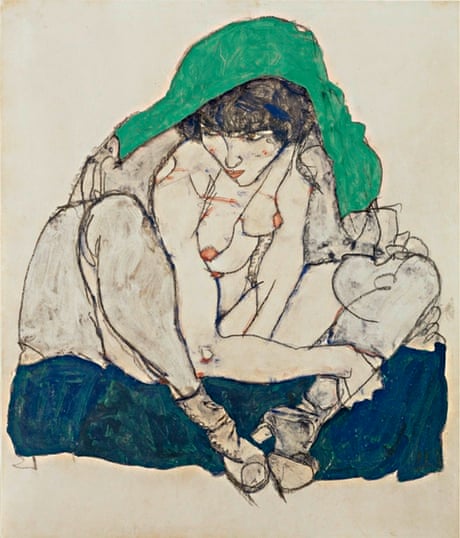
'Crouching woman with green headscarf' (1914) Gouache and pencil, 47 x 31cm.

Schiele’s drawings are punchy, nude full body portraits of women, himself and his lovers, family, cohorts are often depicted in uncomfortable awkward poses, limbs/hands often exaggerated or contorted at unusual angles, the backgrounds bare so as to make sure the subject receives full attention. They are explicit ‘everything’ is literally on show and in some cases, pornographic or as one commentator explained, “Erotic representations without erotic content.” (if you can comprehend such a thing, then this is actually quite an accurate way of putting it, I think!) Conversely, perhaps, in the expressive way in which they are drawn they also hold at times a tender anxiety that wavers between being confrontational, sensual and vulnerable all at the same time. Their daring controversy was not lost at the time they were produced with Schiele actually being imprisoned on ‘public morality grounds’. He was radically ahead of his time and there is a lot that we could discuss and in fact most of what is written about Schiele deals with this debate of the eroticism and perceived opinions of explicitness and censorship in art and modern visual history...blah, blah, blah...

'Sneering Woman (Gertrude Schiele)' (1910) Gouache, watercolour and charcoal with white highlighting, 45 x 31.4cm.

BUT we're not interested in any of that are we? For the purposes of this blog post I'm personally focusing on the 'drawing' and not the subject matter of Schiele’s work really in any way. In truth I went to the Schiele exhibition because I was fascinated to see how they ‘worked’, how they looked as drawings. If I need continue in my own art, I do my utmost to avoid people directly all together! I just don’t find people that interesting (in the art sense). If there are ‘people’ or traces of them in my work they are present more metaphorically with tools or mark making or other referential symbolism. In essence it may be difficult to separate the drawing from the thing it is depicting or derived from as in the case of representational drawing like Schiele’s but just how much do the two influence each if at all is something I am curious to find out.

'Nude self portrait in grey with open mouth' (1910) Gouache and black chalk, 43.8 x 30cm.

What I did find is that Schiele’s figures and representation of the human form are very ‘sculptural’; his self portraits are very angular, his nude female forms very heavily outlined, very ‘solid’ looking. Again, I think this is why I admired them as drawings because they were delivered very confidently, there are no rubbed out lines, all the workings are on show, layered and add to the sense of personality/character in the drawings (particularly in his self portraits). Although they never have the impression of being overworked and there is an immediate confidence and ferventness to capturing these people, these characters, these forms down on paper.  Perhaps like handwriting even whilst the artist himself isn’t ‘present’ within the work, in the sense of being depicted you are always aware of his presence as the hand/the eyes the thinking person looking behind the work. In a slightly feminist way,ahead of its time these drawings have been analysed now as not having the gaze of the male voyeur but of, and I quote, ‘a man who genuinely loves women’. Make of this what you will but for those sorts of reasons they do feel refreshingly honest, real, raw (delete as appropriate) as they are quite unflattering really, a lot of them but inadvertently become quite 'beautiful' in their honesty because of their unabashed, fleshy, bony, hairy, patchy coloured, blemished human openness. A quality in part echoed by the artists choice of using a brown paper surface to draw on the material a more disposable, immediate and everyday one than the preciousness of white paper or canvas surface.

'Fighter' (1913) Gouache and pencil, 48.8 x 32.2cm.

With Schiele’s nudes there is a sense sometimes that the figures are merely a container, an outline in which to house and hang his mark making, stains, colour within (see above). An observation that recalls a similarity with the work of Jim Dine who would almost be a complete abstract expressionist for it not his use of motifs such as hearts, tools, plants or birds that aside from their symbolic qualities he sees them acting as formalistic devices in his words, ‘something to hang the paint on’. I don’t pay this connection of Dine to Schiele too much heed but other than the fact that it helps draw attention to just how diverse the variety of mark making approaches Schiele used in his drawings that perhaps are more easily overlooked in favour of the subject matter.

Needless to say it was an exciting exhibition. Schiele's drawings are as radical today as they were then, just in a different sense of the word that highlights them not for their difference, for their 'controversy' as they did then but for their ability to still hold your attention and be intently surprising. It was an intense, thoughtful and crucially for me, unsettling enough exhibition to make me think about my own drawing habits/techniques so as not to become lazy. 

 In a Spanish flu free scenario it would be intriguing to know what Schiele may have carried on to create next.... though one thing is for certain, his work assures he will never be forgotten.


What are you waiting for?!
Egon Schiele: The Radical Nude is still on at the Courtauld until January 18th!
Images plundered from:

Sunday, 26 October 2014

"Pass me my oil pastels!"

'By words visual imagery is given a second vividness. And writers recast it into a descriptiveness that's infinitely portable.' Ross Feldt

 How does one begin to write about a painter, sculptor such as Anselm Kiefer?! A painter whose work is huge, 'heavy', both in materials and content, multifaceted in its layers and rich surfaces, symbolic, breathtakingly immersive, powerful and to reiterate ,really anything but portable!! To quantify the sheer scale of his works alone in a blog post, had you not ever seen any of them in person is to attempt to imagine an oversized Van Gogh painting on steroids! The physicality in weight, amount of layering, carving and sculpting of materials and paint involved in a Kiefer painting is phenomenal. They almost swallow you up these paintings such is their enormity in size, depth of surface and symbolic content. Hence he's not the sort of artist who is easily done justice in words or photos, in fact, until I saw his work in person (seeing my first Kiefer in 2008) I struggled to see what all the fuss was about. I strongly encourage you to read no  further and go and visit the Anselm Kiefer exhibition at the Royal Academy, London for yourselves.


For those of you unable to get there at present or in need of further convincing then please read on...

The opening quote, perhaps over ambitiously summarises my aspiration for this post (oo-er). It is an ambitious statement indeed and not meant to sound  as pretentious as it first may seem, but is intended a way of justifying the case of 'why bother attempting to write about an artist like Kiefer at all?' [The quote] Taken from a book I recently read called, 'Guston in time' documents the letters between writer, Ross Feld and painter Philip Guston. It is an excellent example of the dialogue between artist and writer, sharing an almost symbiotic relationship as they fuelled and bouncing ideas off the other.I have already alluded to the fact that words cannot really do justice to seeing Kiefer's work in the flesh and more generally I am curious to understand the relationship writing has to visual art, whether it helps or hinders our understanding/enjoyment of the work and is it really possible to make Kiefer's work 'infinitely more portable' through words? Is it foolish even to try?

'Velimir Khlebnikov: Fates of Nations: The New Theory of War. Time, Dimension of the World, Battles at Sea Occur Every 317 Years or Multiples Thereof, Namely 317 x 1, 2, 3, 4, 5, 6 . . . . . . . .' (2011-14)

In this retrospective of the German born artists' work the viewer is taken on a chronological tour from Kiefer's early watercolours and 'Attic' paintings (from the Venice Biennial in 1971) to his present day paintings and installations. Its a wonder how the curators physically fitted it all in! When I mentioned earlier that Kiefer's work is 'heavy' I meant it in both senses of the word. Born in the Black Forest region of Germany in 1945 at the end of the Second World War Kiefer often explores the weight of human history, particularly of Germany's involvement in World War II. Not the lightest of subjects to make work from and is arguably why critics often refer to Kiefer's work dealing with the 'burden of history'; it would have been easy for Kiefer to give in to the darkness and anxiety of such a task, but taught by the mystical and shamanistic teachings of Joseph Beuys, Kiefer's work draws on mythology and symbolism as his starting point, making the work referential to the war but not enclosed by it. His work often symbolically challenging (sometimes confrontationally so), attempts to rewrite the collective memory of the atrocities of war whilst paying homage to it through images of ploughed fields, decaying neo-classical ruins designed by the Nazis) to books and submarines out of materials that also hold symbolic properties such as ash, clay, sunflowers, earth, lead, diamonds (yes you read correctly -take that, Damien Hirst!) and straw. This idea of redemption and remembrance through creating what are thick, obliterated surfaces is, you could argue, both metaphorically a 'covering-over' and 'wiping-out' of history whilst also being a turning-over and creating of something new; it refers to a cyclical movement of time -birth, death and rebirth. The ploughed fields in paintings like 'Nigredo' represent both the end of one thing but the beginning of another. And in other works, sunflowers emerge from ashy dystopian ruins offering a sign of hope and life from despair and destruction.

'Nigredo' (1984)

Viewer stands next to 'Ash Flower' (1983-97) *

The 'passage of life' and link between the celestial/the spiritual and the earthly is a reoccurring theme in Kiefer's work and whilst the human form is often absent his use of perspective and scale draw the viewer into inhabiting and pondering these charred, haunting, desolate spaces. Spaces in which pyramids become mediators between heaven and earth, ruins crumble (are they failed utopias or future dystopias?) and diamonds twinkle off the surface of canvases like constellations whilst also reminding us that they come from the blackest soil found at the base of volcanos; near/far, sky/earth, known/unknown, repulsion/attraction, darkness and light. These are some of the binary opposites which Kiefer uses to represent large concepts or ideas in the same way, I understand, that myth, allegory or metaphor have been used as accessible ways of understanding/contemplating some of life's largest, most intangible questions.  

In Kiefer's paintings the sumptuous surfaces of paint, plaster, concrete, metal, rust, earth and ash cause you to linger, to inspect so that eventually you are engaged in the work long enough to start to wonder what it all means. Both the material and how it has been manipulated hold meaning; the properties of materials like lead holding alchemic associations with transformation as well as compositionally adding to tones of grey within various works. This duality, in the sense that everything is there for a reason gives his work a depth that exceeds from creating a purely a visual experience. Whilst you're walking around the Royal Academy show you can almost here quiet gasps of awe and intake of breath as people fall spell to the lure and vastness of these works that are both beautiful and chilling at the same time. This is one reason why Kiefer is often compared to Romantic painters such as Casper David Friedrich as being inspirational. Equally it is difficult not to get overly poetic in your use of language describing Kiefer's work or loose site of the fact that some of the subjects he is dealing with are very emotive. [He often references the poet, Paul Celan (himself sent to a labour camp during the war) in many of his works.]

 If the spaces and landscapes Kiefer paints are apocalyptical then the only things that remain relatively unscathed are the books which remain a crucial motif in his practice. Once quoted as saying, 'art is an attempt to get at the very centre of truth' Kiefer's use of lead books, physically attached to and mounted on his paintings; is perhaps symbolic of the legacy of books as vessels for human thought, knowledge and culture. It reminds me of a quote I heard or remember from somewhere about when civilisations fail all that remains of them is through their art and culture (forgive me for not being able to find the exact reference). The books in Kiefer's work act as the preservers of history, the remains of human voice in the absence of any human life. Books however, do not necessarily point to a universal sense of 'truth' but do, like art and music document man's search for it. The piece 'The Language of the Birds' placed theatrically at the top of the stairs as you approach the Royal Academy exhibition encapsulates this idea well, marrying the escapism, lofty-ness of books by giving them wings whilst at the same time weighing them down by making them out of lead as though weighted by the knowledge contained in their pages. Perhaps more disturbingly too the spread wings are also reminiscent of the eagle motif used by the Nazis, whilst in its Kiefer-esque duality could also refer to angel wings. By not being too polished and remaining decidedly earthy in its materials it doesn't somehow fall victim into becoming too gimmicky or clichéd.

'The Language of the Birds' (2013)

How does one man deal with the darkness of  the Second World War and remain tireless in pursuit, inexhaustible in a quest for meaning? Somehow Kiefer remains prolific as the sculpture 'Ages of the World' (2014) in the RA exhibition attempts to emphasise. Hundreds of canvases are seemingly precariously stacked into a mountain, pyramid-like pyre with sunflowers sticking out between the sandwiched layers of canvases. It is as though we are seeing the hundreds of works which have been sifted through, created and then discarded in an artistic process/frenzy. Incidentally, it is probably my least favourite works in this exhibition as I think it fails where other paintings and sculptures have tackled a similar idea of presenting 'mass' and cataloguing but have done it better. This piece feels more like a by-product of trying to work something out or search for answers but unlike Kiefer's sketchbooks (which do a similar task) it is more clunky and feels more 'throw-away' or less considered than the sketchbooks. Maybe that is what it is meant to be? In a room adjacent to where 'Ages of the World' is positioned are a couple of paintings depicting the ancient civilisation of Mesopotamia, their surfaces ashen, dusty and worn as though well travelled across a dusty barren landscape prior to being archaeologically revived in the gallery (or so they seem, it is a myth all too befitting of an artist such as Kiefer). They depict the pyramid structures of Mesopotamia that are, I speculate a curatorial decision to be echoed in the 'Ages of the World' sculpture. If anything it feels as though in this preservation of history and predicting of future it is time itself that drives Kiefer to make work so voraciously, by making work that is about past and future before it is too late or before it is forgotten.  

'Morgenthau Plan' (2014) **

The danger with Kiefer is the more you read about his work the more it runs the risk of becoming a bit pretentious, especially if, like me, you aren't at times all too familiar with a wide knowledge of mysticism and mythological references. However I'd argue that his work doesn't need to be over-thought in order to resonate and still communicates at a level of engagement and human consciousness that is accessible to anyone willing to spend time in the presence of these works. This is partly because the symbolism he uses is archetypal but also because it is presented with, for want of a better word 'guts', there's nothing half-hearted about Kiefer, it is big, it is expressive, it is challenging, beautiful and haunting and that gives his work an authority, a presence that can't really fail to prompt a reaction. For me personally, the barometer of whether I enjoyed an exhibition or not usually hinges on two things, whether I feel like I want to write about the exhibition and whether I feel inspired to draw/make studies of work in the exhibition. On this occasion I felt like doing both, hence the blog post and in addition felt compelled to dig out the oil pastels and draw. As for whether it is possible to encapsulate the lived-experience of seeing Kiefer's paintings into words I'll leave that for you to decide. 

Anselm Kiefer is on at the Royal Academy until the 14th of December 2014. Catch it whilst you can!