Showing posts with label alchemy. Show all posts

Saturday, 11 February 2017

Everything You've Come To Expect


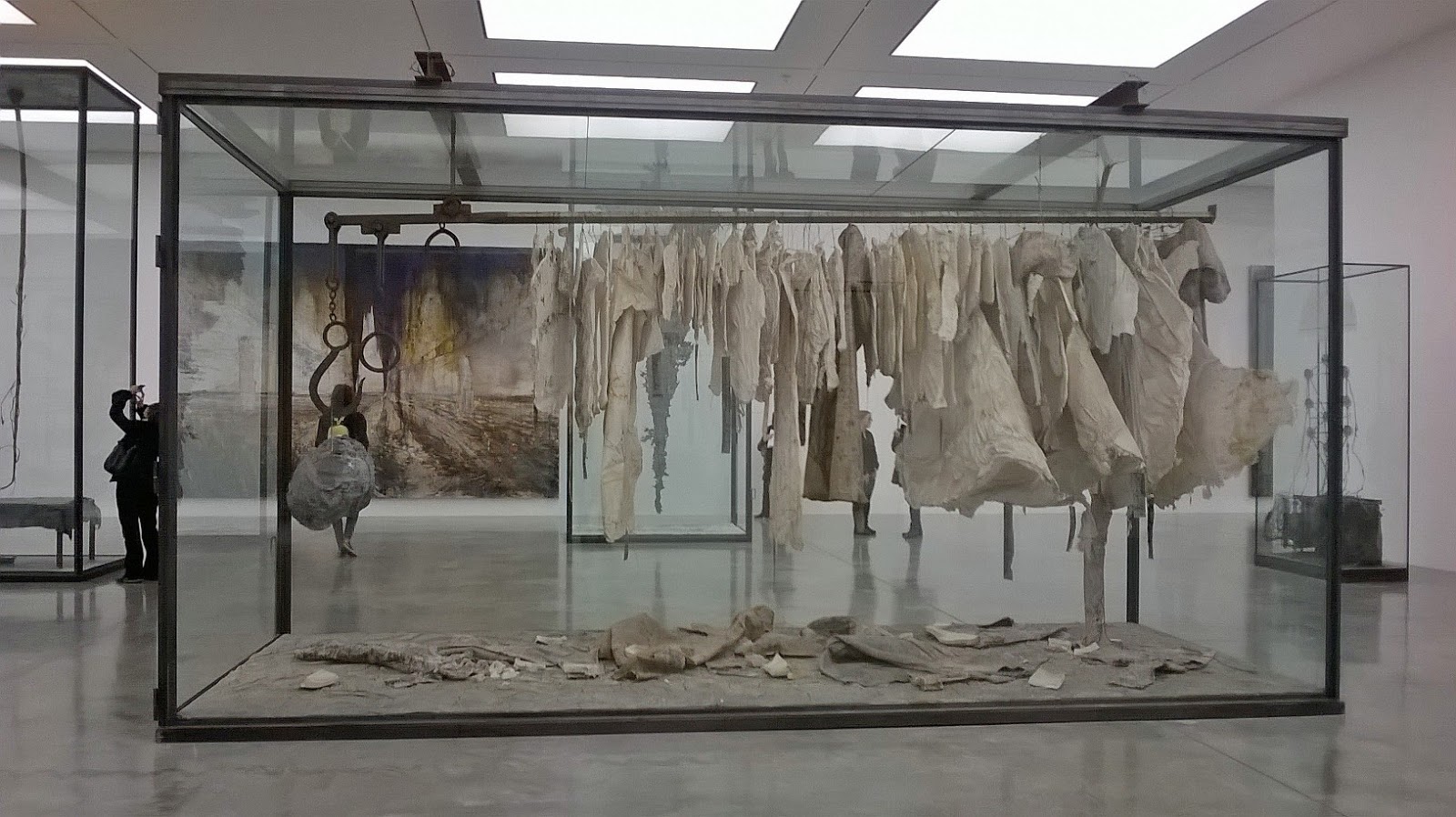
Anselm Kiefer 'Die Walkuren' 2016
Glass, metal, fabric, shellac, plaster, lead, dried plants, ashes. 293 x 560 x 231cm. 

During my Masters there was a lot of talk, generally, but a lot talk specifically about effect and in relation to what effect art works can have on a viewer. Without too much of the philosophy, of which I still struggle to fully grasp, these were phenomenological discussions about how being in the presence of an artwork can physically and/or psychologically effect the viewer; the definition in my mind being like getting goose bumps or hairs going up on the back of one’s neck whilst listening to music. This is a deeper more resonate reaction slightly different from a face-judgement of ‘liking’ something or finding it amusing, sad or happy it is almost a 'being altered' by whatever is experienced. Rather than merely 'viewing' as we are naturally accustomed to with visual art the experience becomes a more holistic one. It is, like most things, of course subjective, but generally I think it has always been easier for me personally, to relate to music, architecture, books and film in this way as ‘causing effect’ rather than visual arts. Yet the later is what I chose to study! It is therefore all the rarer and more precious when it is found and the searching for it is certainly something of a personal motivation come obsession.
 
Therefore I wouldn’t attempt to describe a piece of music that I felt had somehow strongly altered my existence as a human being on this earth to you in writing, I’d just ask you to listen to it. The same could be said of the latest offering from Anselm Kiefer at White Cube Gallery in Bermondsey, London. So monumental, imposing and weighty are some of the latest paintings and sculptures in the exhibition, titled ‘Walhalla’ that describing how it makes one think and feel is no mean feat and even though I have seen a few Kiefer exhibitions now in my now some thirty years, I still feel being in the presence of some of these colossal paintings as awe-inspiring as the first time I’d seen them. In short I hope that in any of my shortcomings to fully describe it, that I may actually inadvertently be describing it better...   
 
Kiefer’s Walhalla begins in a dark, dark, long, lead-walled corridor... Lined with trolley beds covered in hastily dishevelled lead sheets and pillows, its invisible occupants appearing to have fled some unknown atrocity in haste; it is an unnerving space, made more so in being sparsely lit by hanging bare bulbs, it feels institutionalised, regimental, desolate and other worldly. Other worldly or perhaps of-a-world that many of us have been fortunate enough not to have had personally experienced. Reflecting on (amongst other things) Kiefer’s continuous theme with the weight and almost burden of German history from an artist who himself is German. Despite having continuously worked with these ideas throughout his career, they gain new poignancy albeit unintentional, in parallel with the devastating scenes of the crumbling aftermath in the war-torn city of Aleppo.
 
Anselm Kiefer 'Walhalla' 2016 Oil, acrylic, shellac and clay on canvas.
 470 x 760cm.
In these paintings numerous towers and monuments crumble, the citadel has fallen into decay, once fertile lands lay now barren, plundered of their resources or poisoned; rust, dust, ash, molten lead are both surface and destruction at conflict with each other all at once. Is it the end of the world or the beginning of something new; the alchemic, pouring and crashing of elements before the big-bang? So thick are the crusts of some of these are paintings they almost become their own entity; molten lead poured on top has had to be screwed-on in places, there’s so much ‘stuff’ on these surfaces it is as though they have been forged, exposed to the elements and like tectonic plates that continue to shift and crack they corrode and age transforming into new surfaces. In these bleak, almost prophetic dystopias perhaps the latter is an offering of hope that we may not continue to make the mistakes of the past and that perhaps out of this totalitarian destruction change is inevitable and something new may be able to flourish.
 
Anselm Kiefer 'Walhalla' 2016
Oil, acrylic, emulsion, shellac and lead on canvas. 380 x 570 x 42cm.
The corridor with its empty and unwelcoming lead beds offers no rest-bite for reflection on all this, it is a transitional space and the claustrophobic crowding of the beds only forces us to keep moving into one of the six  portals off it, to the left into what are more familiar white-walled gallery rooms, their whiteness all the brighter in contrast to the ash greyness from which we entered. The mere treatment of this exhibition as almost one-whole installation is in itself a powerful thing to experience and takes upon the collective concept of Valhalla at its core. The transition from dark to light being amongst the most simple but effective ways of conveying life and death, conscious and unconscious, the realms of night vs. day. Valhalla in Norse mythology seen as the underworld, “the hall that houses dead distinguished warriors, it is also a place of perpetual fighting” another reminder perhaps alluding to those soldiers and civilians caught-up in wars past and present? These myths seamlessly interwoven amongst conflicted rupturing surfaces in his paintings and in the placement of symbols such as the anvil, the spear, in all of Kiefer’s work for those who seek to look for them.
 
Anselm Kiefer 'Arsenal' 1983-2016 Lead and Mixed media. Dimensions variable.
Kiefer is an artist who has almost enviably gained the luxury of having vast quantities of material and space, technicians at his disposal to which he still does in ambitious abundance, here in Walhalla a historical or library style archive, titled 'Arsenal' is bursting with the debris of the materials he has worked with throughout his career. I suspect more than an element of recycling to be going-on, it is as if now Kiefer may be beginning to address the archive of his own history and career as an artist within his work. Salt, glass, paper, photos printed on reams of lead and seeds spill out of chests of drawers, safes, atop rusty print presses and racks of lead books stacked from floor to ceiling. Am I in a medieval apothecary? A ransacked archive? Or scene from a Harry Potter movie? At this point I am convinced it has become all a bit  theatrical but it is a theatre of which I am happy to have been invited in to explore if nothing for its rarity and glut of surfaces, shapes, nooks and crannies and materials of which remain a visual delight.   
 
Anselm Kiefer 'Walhalla' 2016 Oil, acrylic, emulsion and shellac on canvas. 380 x 570cm.
The preservation and decay of history is explored further in the use of museum vitrines in the exhibition that encase large sculptural works made from stacked bicycles, petrified sunflowers, dead trees and stiffened clothing. Most things in this exhibition appear to be dead or suspended in some way as such is the absence of any figures in the beds, clothing and landscapes albeit except for a lone figure in a photograph at the end of that foreboding corridor, who too offers little solace, as they are depicted walking off into the distance abandoning the viewer in this non-space or purgatory. It is all a perpetual reminder of the fragile mortality of people against the accumulation of what we produce and legacy of history and time itself. Maybe the exhibition is all a little contrite in its contextualisation to ideas of Norse mythology and land of the dead but I think can still be appreciated for its use and breadth of materials alone. It is also in danger of offering much of what we have already come to expect from a Kiefer exhibition, nonetheless I think it important to approach it with fresh eyes and I hope I have already proven why it is still relevant to today. I never fully able to understand what ‘effect’ was during my MA but something in my gut tells me that Kiefer’s work has it in spades.
 
Anselm Kiefer’s Walhalla is on at Bermondsey White Cube until February 12th 2017(one more day, but do catch it if you can) http://whitecube.com/  
 
*These photos are my own. If you're in one and would like me to remove it please contact me.

Sunday, 26 October 2014

"Pass me my oil pastels!"

'By words visual imagery is given a second vividness. And writers recast it into a descriptiveness that's infinitely portable.' Ross Feldt

 How does one begin to write about a painter, sculptor such as Anselm Kiefer?! A painter whose work is huge, 'heavy', both in materials and content, multifaceted in its layers and rich surfaces, symbolic, breathtakingly immersive, powerful and to reiterate ,really anything but portable!! To quantify the sheer scale of his works alone in a blog post, had you not ever seen any of them in person is to attempt to imagine an oversized Van Gogh painting on steroids! The physicality in weight, amount of layering, carving and sculpting of materials and paint involved in a Kiefer painting is phenomenal. They almost swallow you up these paintings such is their enormity in size, depth of surface and symbolic content. Hence he's not the sort of artist who is easily done justice in words or photos, in fact, until I saw his work in person (seeing my first Kiefer in 2008) I struggled to see what all the fuss was about. I strongly encourage you to read no  further and go and visit the Anselm Kiefer exhibition at the Royal Academy, London for yourselves.


For those of you unable to get there at present or in need of further convincing then please read on...

The opening quote, perhaps over ambitiously summarises my aspiration for this post (oo-er). It is an ambitious statement indeed and not meant to sound  as pretentious as it first may seem, but is intended a way of justifying the case of 'why bother attempting to write about an artist like Kiefer at all?' [The quote] Taken from a book I recently read called, 'Guston in time' documents the letters between writer, Ross Feld and painter Philip Guston. It is an excellent example of the dialogue between artist and writer, sharing an almost symbiotic relationship as they fuelled and bouncing ideas off the other.I have already alluded to the fact that words cannot really do justice to seeing Kiefer's work in the flesh and more generally I am curious to understand the relationship writing has to visual art, whether it helps or hinders our understanding/enjoyment of the work and is it really possible to make Kiefer's work 'infinitely more portable' through words? Is it foolish even to try?

'Velimir Khlebnikov: Fates of Nations: The New Theory of War. Time, Dimension of the World, Battles at Sea Occur Every 317 Years or Multiples Thereof, Namely 317 x 1, 2, 3, 4, 5, 6 . . . . . . . .' (2011-14)

In this retrospective of the German born artists' work the viewer is taken on a chronological tour from Kiefer's early watercolours and 'Attic' paintings (from the Venice Biennial in 1971) to his present day paintings and installations. Its a wonder how the curators physically fitted it all in! When I mentioned earlier that Kiefer's work is 'heavy' I meant it in both senses of the word. Born in the Black Forest region of Germany in 1945 at the end of the Second World War Kiefer often explores the weight of human history, particularly of Germany's involvement in World War II. Not the lightest of subjects to make work from and is arguably why critics often refer to Kiefer's work dealing with the 'burden of history'; it would have been easy for Kiefer to give in to the darkness and anxiety of such a task, but taught by the mystical and shamanistic teachings of Joseph Beuys, Kiefer's work draws on mythology and symbolism as his starting point, making the work referential to the war but not enclosed by it. His work often symbolically challenging (sometimes confrontationally so), attempts to rewrite the collective memory of the atrocities of war whilst paying homage to it through images of ploughed fields, decaying neo-classical ruins designed by the Nazis) to books and submarines out of materials that also hold symbolic properties such as ash, clay, sunflowers, earth, lead, diamonds (yes you read correctly -take that, Damien Hirst!) and straw. This idea of redemption and remembrance through creating what are thick, obliterated surfaces is, you could argue, both metaphorically a 'covering-over' and 'wiping-out' of history whilst also being a turning-over and creating of something new; it refers to a cyclical movement of time -birth, death and rebirth. The ploughed fields in paintings like 'Nigredo' represent both the end of one thing but the beginning of another. And in other works, sunflowers emerge from ashy dystopian ruins offering a sign of hope and life from despair and destruction.

'Nigredo' (1984)

Viewer stands next to 'Ash Flower' (1983-97) *

The 'passage of life' and link between the celestial/the spiritual and the earthly is a reoccurring theme in Kiefer's work and whilst the human form is often absent his use of perspective and scale draw the viewer into inhabiting and pondering these charred, haunting, desolate spaces. Spaces in which pyramids become mediators between heaven and earth, ruins crumble (are they failed utopias or future dystopias?) and diamonds twinkle off the surface of canvases like constellations whilst also reminding us that they come from the blackest soil found at the base of volcanos; near/far, sky/earth, known/unknown, repulsion/attraction, darkness and light. These are some of the binary opposites which Kiefer uses to represent large concepts or ideas in the same way, I understand, that myth, allegory or metaphor have been used as accessible ways of understanding/contemplating some of life's largest, most intangible questions.  

In Kiefer's paintings the sumptuous surfaces of paint, plaster, concrete, metal, rust, earth and ash cause you to linger, to inspect so that eventually you are engaged in the work long enough to start to wonder what it all means. Both the material and how it has been manipulated hold meaning; the properties of materials like lead holding alchemic associations with transformation as well as compositionally adding to tones of grey within various works. This duality, in the sense that everything is there for a reason gives his work a depth that exceeds from creating a purely a visual experience. Whilst you're walking around the Royal Academy show you can almost here quiet gasps of awe and intake of breath as people fall spell to the lure and vastness of these works that are both beautiful and chilling at the same time. This is one reason why Kiefer is often compared to Romantic painters such as Casper David Friedrich as being inspirational. Equally it is difficult not to get overly poetic in your use of language describing Kiefer's work or loose site of the fact that some of the subjects he is dealing with are very emotive. [He often references the poet, Paul Celan (himself sent to a labour camp during the war) in many of his works.]

 If the spaces and landscapes Kiefer paints are apocalyptical then the only things that remain relatively unscathed are the books which remain a crucial motif in his practice. Once quoted as saying, 'art is an attempt to get at the very centre of truth' Kiefer's use of lead books, physically attached to and mounted on his paintings; is perhaps symbolic of the legacy of books as vessels for human thought, knowledge and culture. It reminds me of a quote I heard or remember from somewhere about when civilisations fail all that remains of them is through their art and culture (forgive me for not being able to find the exact reference). The books in Kiefer's work act as the preservers of history, the remains of human voice in the absence of any human life. Books however, do not necessarily point to a universal sense of 'truth' but do, like art and music document man's search for it. The piece 'The Language of the Birds' placed theatrically at the top of the stairs as you approach the Royal Academy exhibition encapsulates this idea well, marrying the escapism, lofty-ness of books by giving them wings whilst at the same time weighing them down by making them out of lead as though weighted by the knowledge contained in their pages. Perhaps more disturbingly too the spread wings are also reminiscent of the eagle motif used by the Nazis, whilst in its Kiefer-esque duality could also refer to angel wings. By not being too polished and remaining decidedly earthy in its materials it doesn't somehow fall victim into becoming too gimmicky or clichéd.

'The Language of the Birds' (2013)

How does one man deal with the darkness of  the Second World War and remain tireless in pursuit, inexhaustible in a quest for meaning? Somehow Kiefer remains prolific as the sculpture 'Ages of the World' (2014) in the RA exhibition attempts to emphasise. Hundreds of canvases are seemingly precariously stacked into a mountain, pyramid-like pyre with sunflowers sticking out between the sandwiched layers of canvases. It is as though we are seeing the hundreds of works which have been sifted through, created and then discarded in an artistic process/frenzy. Incidentally, it is probably my least favourite works in this exhibition as I think it fails where other paintings and sculptures have tackled a similar idea of presenting 'mass' and cataloguing but have done it better. This piece feels more like a by-product of trying to work something out or search for answers but unlike Kiefer's sketchbooks (which do a similar task) it is more clunky and feels more 'throw-away' or less considered than the sketchbooks. Maybe that is what it is meant to be? In a room adjacent to where 'Ages of the World' is positioned are a couple of paintings depicting the ancient civilisation of Mesopotamia, their surfaces ashen, dusty and worn as though well travelled across a dusty barren landscape prior to being archaeologically revived in the gallery (or so they seem, it is a myth all too befitting of an artist such as Kiefer). They depict the pyramid structures of Mesopotamia that are, I speculate a curatorial decision to be echoed in the 'Ages of the World' sculpture. If anything it feels as though in this preservation of history and predicting of future it is time itself that drives Kiefer to make work so voraciously, by making work that is about past and future before it is too late or before it is forgotten.  

'Morgenthau Plan' (2014) **

The danger with Kiefer is the more you read about his work the more it runs the risk of becoming a bit pretentious, especially if, like me, you aren't at times all too familiar with a wide knowledge of mysticism and mythological references. However I'd argue that his work doesn't need to be over-thought in order to resonate and still communicates at a level of engagement and human consciousness that is accessible to anyone willing to spend time in the presence of these works. This is partly because the symbolism he uses is archetypal but also because it is presented with, for want of a better word 'guts', there's nothing half-hearted about Kiefer, it is big, it is expressive, it is challenging, beautiful and haunting and that gives his work an authority, a presence that can't really fail to prompt a reaction. For me personally, the barometer of whether I enjoyed an exhibition or not usually hinges on two things, whether I feel like I want to write about the exhibition and whether I feel inspired to draw/make studies of work in the exhibition. On this occasion I felt like doing both, hence the blog post and in addition felt compelled to dig out the oil pastels and draw. As for whether it is possible to encapsulate the lived-experience of seeing Kiefer's paintings into words I'll leave that for you to decide. 

Anselm Kiefer is on at the Royal Academy until the 14th of December 2014. Catch it whilst you can!