Showing posts with label Lee Lozano. Show all posts

Sunday, 4 October 2015

Art That You Really Really Will Not Have Seen Anywhere Else!

Yet another, but perhaps more self-publicising reason to visit our exhibition at The Old Brick Workshop this Art Weeks is to see twelve entirely new works I've created over the course of this year. After having a fairly substantial break from exhibiting anywhere, it is very exciting, enjoyably nerve-wracking  and important to me to have the opportunity to receive feed back and show new work again. They include some familiar themes of mine, namely tools as well as a few new surprises! [See: http://spannerintheworkz.blogspot.co.uk/2015/10/art-weeks-2015-sneak-preview.html]
 
Apart from being a shameless plug for the exhibition this is the first in a series of posts I’ll be writing about that recent work in an attempt to understand it better and share a few thoughts on the making or thinking behind some of the work.

Natalie Parsley 'We Two Tools Together Clinging' 2015 Mono print and ink on paper. 24 x 32cm.

The more familiar tool related thread to my practice includes the work, ‘We Two Tools Together Clinging’ (pictured) inspired from Lee Lozano’s drawings of tools, depicted anthropomorphised locked in embrace or mortal combat [See: http://spannerintheworkz.blogspot.co.uk/2015/07/post-lozano.html ]. The colour scheme unintentionally mirrors that of an early David Hockney painting, ‘We Two Boys Together Clinging’ whose title I have deliberately manipulated to fit my own. That is pretty much where the similarities end and recommend you visit the real thing as Hockney’s is an amazing painting!  Hockney’s references a headline from a climbing accident, "Two Boys Cling to Cliff All Night" which he propagandised into being about his own homosexuality at a time when it was taboo to shout about it publically/openly. I haven’t really assigned sexuality to the tools in my work, it could really be interpreted either way as I’m more interested in it being about a relationship of sorts rather than comment on gender specifically. The ‘clinging’ in the title of my work alludes to the human sense of ‘embrace’ as well as the function of clamps as a tool, to cling, hold or grip something. If assigning human attributes to inanimate objects in this work, the word-play of ‘tools’ could be read both literally about tools but also the derisive  slang of ‘being a stupid or socially inept person’. Rather than mockingly it can sometimes be empowering when such negative labelling is adopted by those it is originally intended to make fun of and there is a sort of strength in unity that these two ‘tools’ of any gender or social commentary have come together in a form of embrace. One could read it that way or of course, it could simply just be two clamps locked together! I enjoy discussion about the double or multiple meanings of art, how it is interpreted. At the very least that is what I attempt to do when I view or write about work I've seen. What is significant and important to me about this piece of my work however is that it is one of the first times I’ve used a title to manipulate the reading of a drawing I’ve created. That’s quite significant and interesting to me and will be something I think I will revisit again for future work.
 
David Hockney 'We Two Boys Together Clinging' 1961 Oil on Board. 48 x 60"
You can see my work as part of the exhibition at The Old Brick Workshop, Wellington. Open daily 11-6 now until Sunday October 18th

Sunday, 12 July 2015

Post Lozano

  If she were alive today would Lee Lozano be a blogger? I’d like to think so, as at the very least I think the medium would have been deeply interesting to her, its occupation with the ‘global audience’, exposure for the written word and debates on censorship and what constitutes public/private in an age when almost every aspect of people’s lives is documented online.  
 
But where are my manners?! Few people I know have ever even heard of the artist, Lee Lozano and to some extent that is exactly  what she wanted, self-creating her own infamy with a body of work titled ‘Dropout piece’ whose primary aim was to reject and create self-anonymity from the art world.
 
“She became competitively uncompetitive, ‘I will not seek fame, publicity or suckcess.’ That single declaration remains the cleanest summation of what Dropout Piece is actually amounted to: a total disengagement from all professional art world ambition.”1
 
In succeeding to do so, but still continuing to work privately and continue her practice (in the form of copious notebooks of thoughts and experimental performance pieces) she inadvertently created a legacy in the art of self-oblivion. Born 1930 in New Jersey she graduated philosophy and natural sciences before marrying and in four years divorcing, architect Adrian Lozano whilst studying towards her Bachelors in Fine Art. In the 60s she moved to New York befriending artists such as Stephen Kaltenbach and Carl Andre in which increasingly, due to the likes of artists such as Michael Heizer and Robert Smithson, the art was beginning to emerge outside the institution of the gallery/exhibition space. This was to be influential in the development of Lozano’s later performance and conceptual pieces.

IMAGE 1. Lee Lozano Installation view of the ‘Wave Series’ (1969) oil on canvas.

  It is a compelling mystery that she is so unheard of given the prolific nature of work she actually produced. Her decision to disappear from the art world was not made out of apathy or an act of attention-seeking but a rebellion, a protest piece against the disillusionment and superficiality of the art world. Additionally it was met with shared adversity amongst many of the artists Lozano associated herself with along with the anti-war protest and feminist movements in America at the time. Prior to ‘Dropout Piece’ Lozano was gaining recognition for her series of large ‘Wave’ paintings that share a similar flat, minimalist sense of abstraction and use of colour to Barnett Newman (IMAGE 1) but becoming increasingly frustrated at the schmooze-filled pomposity of the art scene and after undergoing an extensive period of psychoanalysis she revolted against ‘expectation’ and resorted back to her earlier ‘word’ works; conceptual pieces handwritten in copious notebooks. This almost cataclysmic shift to something different in her practice, I feel has so much in common (but so little written about it) in relation to Philip Guston’s own choosing to retract from his success in the art world as a abstract expressionist painter to pursue his own path, his own re-invention as an artist. A bold thing to do and one that is not without risk nor always successful. Lozano herself very aware of the pressures and expectations put upon artists by both themselves and, more significantly for the motivation for ‘Dropout piece’; the expectation that the art world places upon the artists it is so reliant on. Lozano expresses this quite honestly and refreshingly defiantly at a lecture she gave on creative production,
 
“For example, what is expected of any artist or any creative person, as opposed to what really happens? Everyone knows that an artist’s best work often covers a very short period of time, yet the artist is expected to function on a high, high level of performance at all times. And, if an artist does very good work at one period in life, he or she is always, actually competing with their own great period of work. It’s almost very rare that an artist does high quality work and maintains this great period throughout their career. Yet it’s expected of him.”2
 
Prior to any of this however she had been making drawings, gestural paintings and caricatures of tools, screws, nails, flexi-pipes, sharpeners and mechanical objects which she collected off the streets and her ‘former’ studio floor (IMAGE 2). And for me, personally, it is her tool work made between 1964-67 that is particularly interesting...
 
IMAGE 2. Lee Lozano ‘Untitled’ (1964) Graphite and crayon on paper. 23 x 16”
 
IMAGE 5. Lee Lozano ‘No Title’ (1963-64) graphite and crayon on paper. Dimensions unknown.
 
In her series of tool drawings and large paintings tools are depicted with great intensity, often in extreme close-up with a very physical use of mark-making.
 
“In Lozano’s hands, screws are no longer a neutral means to hang a painting or set a bookshelf but rather explicit euphemisms of sexist logic: anthropomorphized machines aggressively screwing in and out of each other in acts of overdetermined functionality, regardless of pain or pleasure.”3
 
The concept of anthropomorphising tools being one reason I am interested in Lozano’s work,
 
"Given life they automatically become frenzied beings – clamps, pliers, screwdrivers and hammers fondling and struggling with each other in a kind of dangerous courtship."4 (IMAGE 3)
 
IMAGE 3. Lee Lozano ‘No Title’ (1963-64) graphite and crayon on paper. Dimensions unknown.
 
In my own work (IMAGE 4) the tools I depicted were nearly always unconsciously in groups or sets. I like to think this was a compositional decision; that the positive and negative shapes created by layering/overlapping the tools more interesting visually than drawing them statically or in rows. However, the large scale and intensity with which I drew them dictated otherwise, making them often more intimidating or, similarly to Lozano personified in some way. Tools are objects of character, their patina giving them unique surfaces and whilst I did not directly respond to imbuing them with the courtship and coupling in Lozano’s drawings I accept that other people could read into them in this way. If anything it makes me want to make new work that specifically explores these ideas. 'Tools and their relationships'! Ha!

IMAGE 4. Natalie Parsley. Tools 2. 2008. Oil and gloss mono print on paper. 250 x 220cm.

 Lozano’s tool works aren’t exactly comfortable viewing aside from the fact they aren’t always particularly accurately drawn, their composition of being squashed and almost perverse intimate close-ups of these familiar objects that creates feeling of claustrophobia or threat; met with the large scale of some of the paintings,
 
“The huge formats of many of the Tool Paintings give these dynamic images an overpowering forcefulness.”5
 
These are paintings that intend to intimidate and are as aggressive as they are sexually direct and full of double entendre and masculinity (IMAGE 5). In their exaggerated extremity they also have many parallels with comic books that both influenced Lozano and whose word-play inspired her written pieces. But the fact Lozano is a woman depicting these heavily masculinised objects with equally masculine connotations gives them a sort of anarchic sense of taking claim or ownership of them.
 
"Lozano’s early work was irreverent and unabashed, propelled by an overt and oversexed drive to misbehave as much as possible for a woman in the early 60s."6
 
As a woman myself, conveniently, who has depicted tools in her art for many years now it is incredibly liberating to discover Lozano’s tool work as it openly challenges stereotypes and throws an interesting perspective on my own relationship with tools that had previously, relatively gone unconsidered.  Perhaps being in a more liberal age of equality than America in the 60s I don’t see gender-equality as much of an issue regarding my own work in the sense it isn’t driven out of a desire to protest or misbehave but none-the-less after spending the majority of my tool-based art career looking at the prints of Jim Dine it is refreshing to counterbalance this perspective with a female artist. Dine and Lozano’s drawings have a similarity in their intensity of looking and use of drawing as a means of expression and almost cathartic ‘drawing-out’ which I too have frequently referred to in my own practice. This and the fact that each of them underwent bouts of psychoanalysis is evidence that there is more that unites the likes of Lozano and Dine other than just in their representation of tools.

Lee Lozano ‘No Title’ (1964) oil on canvas (two parts) 275.2 x 168.5 x 5.2cm.

  Where Lozano differs, is that Dine’s tools are relatively more static but ‘sexually’ charged by the mark-making that surround them (IMAGE 6); Lozano’s tools are cropped so that the moving-parts of the tool, the parts with teeth, which cut, which flatten and squeeze are amplified so have this feeling of being  more menacing, at times perverse and certainly more physical. In a precursor to Sol Lewitt, Lozano wrote her own list of verbs and used these ‘doing’ words as titles for her tool paintings, further underpinning associations with action/use.  
 
In my own practice an ongoing thread has been the idea that the function of objects is to be ‘put to use or be possessed’ and my MA explored someway into unravelling what it means to ‘use’ a tool and/or ‘possess’ one. Specifically I was interested if drawing could be a form of use and possession largely fuelled by a quote by Jim Dine who of his tool prints stated, "I wanted to possess them and what better way to possess them than to draw them"7. Whether Lozano was trying to possess them or not she was encapsulated in a form of ’Tool Mania’ and possessive lifestyle mixed with periods of casual and heavy drug-taking. It was as though she was seeking of ways in which to escape reality and thinking through frantically making work,
 
"...concerns shaping her practice, involving intimacy and exposure, the incommunicatability of living in your head and the psychological state of possession, whether taking possession or being possessed."8
 
IMAGE 6. Jim Dine ‘Untitled (C Clamp)’ from Untitled Tool Series (1973).
 
The idea of ‘incommunicatability of living in your head’ struck me as yet another example of the similarities that Lozano’s tool drawings have to Guston’s later works (IMAGE 7). They share the similarity of being inwardly bodily; ‘living in your head’ which Lozano conveyed with her treatment to thickly apply paint like a skin and make marks with a frenzied intensity, expression and physicality that are comparable to Guston’s fleshy, skin-crawlingly pink, eyeball filled figures. A depiction of what it feels like on a very sensorial level, to be inside a head. As cartoonist, Chris Ware writes of Guston’s work so succinctly,
 
"...these paintings are not what it looks like to see a human being, but what it feels like to inhabit one. Philip Guston is the first painter, ever, to truly paint a portrait from the inside out."9
 
There is, I feel without doubt a rawness of emotion in both Lozano's and Guston's drawings aside from their subject matter that warrants further research than I have gone into here. I see this post as the beginning of an on-going enquiry into Lozano's work.

IMAGE 7. Philip Guston ‘Rug’ (1980) Lithograph on paper, 495 x 736 mm.

Lee Lozano ‘Untitled (Be this occasionally)’ (1964) Graphite and crayon on paper. 13 x 18.5”
 
Lozano’s tool drawings and paintings only made for a short span of her artistic career which evolved from the early tool works to minimalist paintings and later written conceptual pieces performed often in private. Despite the diversity and shifts within her practice her reasoning and resistance to any sense of categorisation within the art system and nonconformity prevailed seeking recognition and appraisal amongst her peers rather than public.
 
Her work highlighted the dangers of expectation and assumption and demonstrated that artists are able to reinvent themselves and take on many evolutions within their practice, but most of all being admirable for not being afraid to stick two fingers up at the symbiotic, superficial relationship between artist and the art world, in fact making it into the catalyst for creating work. This path consequently led her down an incredibly self-destructive path and at times reliant on the support of friends and family which she continued to rely on up until her being diagnosed for cervical cancer which she died from in 1999 (she was 69).  Yet despite her elusiveness and relatively premature death her work went on to influence a generation of conceptual and performance artists working in America and thanks to the preservation of many of her works, countless since. I have known of her work since 2011, first discovering her in a book on drawing –since then I have felt obliged to unveil some of the mystery and have continued to seek her work out in exhibitions and in books. I still want to find out more, captivated by both the shifts within her practice, her mystery and determination met with anarchy against the establishment.
 
 That and the tools, of course!  
 

1 LEHRER-GRAIWER, S (2014) Lee Lozano ‘Dropout Piece’ Afterall Books: London p57
2 IBID p59/60
3 FOLIE, S (2011) ‘Lozano Tools’, An Art Service Publications; Minneapolis
4 IBID
5 IBID
6 LEHRER-GRAIWER, S (2014) Lee Lozano ‘Dropout Piece’ Afterall Books: London p28
7 DINE, J (2005) Jim Dine: Tools and Plants Alan Cristea Gallery: London p5.
8 OpCit p18


Thursday, 25 June 2015

Tongue tied or speaking in tongues?

If you are lucky enough to visit ‘Slip of the Tongue’ at Punta Della Dogana in Venice this year there will be some points during your viewing where you will look possibly at a stone axe head sticking out the top of a block of clay and question ‘what does this all mean?!’ ‘uh....’
 
That’s right! This post marks the glorious return of ‘the bit pretentious one’ art gallery, Punta Della Dogana, Venice. Hard to believe it was almost two years since my last visit during the 2013 Biennale when I initially dubbed the contemporary art gallery as the ‘more pretentious’ of its Venetian counterparts [see http://spannerintheworkz.blogspot.co.uk/2013/12/the-bit-pretentious-one.html]. June 2015 and I am not deterred, as before, first opinions can be misleading and I was excited to see what was in store second time around. In fact my visits to PDD are becoming some of the most insightful experiences into art I have ever had at an exhibition. This post reflects on some of those thoughts.
 
People should not be afraid to not understand art. I think the image of authority projected by the galleries we place art in can often dictate otherwise and there is a pressure or intimidation found in their reverend silence and cathedral-like viewing spaces that fills people with a sense of the unknown. I don’t think this is the fault of gallery spaces who go to great lengths to ensure their buildings are as welcoming, user-friendly and accessible as possible and it is a double-edged sword, galleries need to be authoritative to give the work a kind-of cultural backing or approval that gives conviction that, for example, this sheet of gold leaf on the floor is ‘art’. However I do not see any of this as a bad thing and think it is as important to not know, expect the unexpected as much as it is to-know something. With art particularly the complexity of each individual piece and ways in which meaning is constantly shifting over time can mean that no one could ever claim to understand it all, often not even the artist. On that note the introduction to the exhibition at PDD states, “Each of the objects and works of art (around 120) presented in the exhibition “Slip of the Tongue” seem to partake in this idea that the activity of the artist is aimed at the preservation and afterlife of objects rather than of their interpretation.”

Hubert Duprat 'Volos' (2013)
Equally it would be wrong to assume that our soul engagement or pleasure from art should be in attempting to understand/interpret it. Asking what a stone axe head in a lump of clay is all about is a perfectly reasonable question, but may actually have nothing to do with arts knowledge or experience brought to the work by the viewer, but highlights that there must be something intriguing or something possibly worth knowing about the art work. Conversely, when I find myself in an exhibition asking myself what various works are about, I then ask ‘why/what is it about the work I’m looking at that makes me interested in it?’ In the case of our axe head I was initially attracted, of course, because it featured a tool and there was something totemic-like or primal about the way in which it was quite ‘simply’ stuck in the top of the clay block that aroused suspicion. I wanted to know why the clay had been kept in its clear shrink wrap casing as to being left to dry and whether this made it, due to the condensation formed under the wrap a bit like a ‘breathing sculpture’. It raised connections in the art history part of my knowledge of Arte Povera, the ready-made as well as something more tribal or ancient. Even without this assumed knowledge I think people would pick up on the clues in the work but admittedly it requires more effort than some work. The work is part of a series in this exhibition by French artist, Hubert Duprat. Titled ‘Volos’ it is in fact named after the Greek island where in an archaeology museum a  pre-Cycladic polished axe head replaces a human head in a  terracotta sculpture of a human chest. The specifics of this may have taken some deducing or would require knowledge of pre-Cyladic sculpture, but the essential ideas of something ancient, and a breathing or flesh-like form could be read by most.

Nairy Baghramian 'Retainer' (2013) Cast aluminium, silicon, polycarbonate, chromed metal, rubber.
 
Despite its more demanding nature ‘Slip of the Tongue’ is one of the more digestible exhibitions in this year’s Biennale in which Danish artist, Danh Vo curates. Featuring some 39 artists from throughout art history; mediƦval miniaturists, Rodin, Picasso, Francesco Lo Savio, Carol Rama, Paul Thek, Nancy Spero and Lee Lozano, Marcel Broodthaers, Hubert Duprat, Elmgreen and Dragset to Fischli and Weiss it is still pretty sizable but in true Punta Della Dogana style the works featured are at times difficult to spot given, at times vast quantities of space to single works of art. Art Tourists expecting a similar Biennale style art binge will relate to its ‘bit pretentious’ reputation as was my similar false judgement from two years ago. However in contrast to the relentlessness and scale of the Biennale central exhibition itself, PDD stands out for demonstrating that by giving artwork more space (irrespective of its scale) it forces us to consider/notice it more. This is an exhibition that rewards thoughtful interpretation for those who take the time to look for it.
 
 Elsewhere a row of yellow, cheese-like melting plastic squares are supported into a row by a wire structure which arguably regiments them as much as it supports. Therein lies our beginnings to interpreting this work, a dynamic visual puzzle in the language of materials, shape, form and meaning. The wire denotes some kind of forcible correction and reminded me of braces or an abstract wall. The plastic yellow sheets then become teeth-like or the object which is being manipulated by the wire, their shiny surface mimicking a feeling of wetness associated with the teeth/mouth idea. The work, titled ‘Retainer’ is by Nairy Baghramian and in directly avoiding a representation of a set of braces/retainer it is meant to conjure ideas of the mouth as a space that changes when it is open or closed.  The whole thing does look fairly awkward and not exactly aesthetically pleasing but to quote the catalogue rather, ‘reveals the ugliness that proceeds correction’.
 
Baghramian also has two other works in the show, one of which the title piece for the exhibition, ‘Slip of the tongue’ (continuing the mouth theme). The work itself a combination of epoxy, resin, polystyrene and concrete series of phallus looking sculptures which are meant to be more tongue-like but in their uncertainty convey the idea of Freudian-slips and stumbles of language and how it shapes our identity.
 
Danh Vo 'We the People'  Detail (2011-2013) Copper.
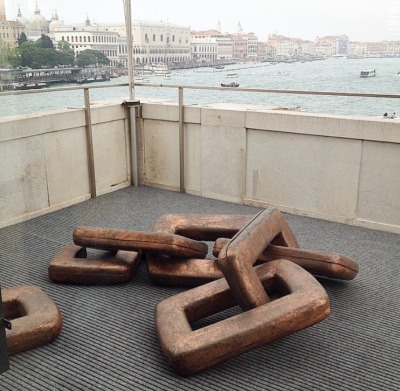
In relation to the curator Danh Vo’s work the theme of the broken and the mended, the beautiful and the delicate is referred to not only in the artists he has selected but also his own practice which in some cases combines fragments of classical sculpture with modern-abstract concrete or wooden forms that both appear to hold-together and prop-up the original sculpture and interfere with it at the same time. In Vo’s sculpture, ‘We the People’ a set of giant broken and joined chain-links, is derived from a painting showing a cross-section inside the Statue of Liberty by Martin Wong (also in the exhibition). The links also refer to a piece Vo did about the Statue of Liberty in New York five years earlier. The idea of making links and literally depicting them is woven throughout the exhibition so that the work can be read both individually and then a second time in relation to the work surrounding it.  
 
Danh Vo 'Untitled' (2015) Gold, cardboard, various iron and farm tools.
 
Where this particular exhibition also challenges expectations is in that it has been curated by an artist. Whether it is perhaps because ‘artist as curator’ is more intuitively visually aware than a curator is, I don’t know but there could be argument in saying that this exhibition overall feels far more cohesive and more reflective of Vo’s practcice in its selection of works than that of the theme-based grouping of the Biennale ‘All the World’s Futures’ curated by Okwui Enwezor. Even down to the presenting of work aesthetically together is well thought-out with similar neutral tones, sepia hues and scales and sizes that vary from the elegantly small to the ambitiously large. From the late 19th century chandelier from the ballroom of the former Hotel Majestic in Paris which functioned as the headquarters for the German military in WWII to Sigmar Polke’s potato house and Andres Serrano’s ‘Piss Christ’ there is a LOT of art in this exhibition that begs to be thought about and how it talks to the other pieces that surround it paints a complex set of ideas around identity and biographical links to Vo’s mixed heritage of being a Vietnamese-born Danish artist that I’m still left unravelling weeks after having seen it!

Assisted in this plight visitors are burdened with what is an almost alarmingly comprehensive accompanying twenty-three page document which I think reads better as more of a catalogue to read after the exhibition rather than during. Tip; never find yourself reading the text in the gallery longer than you are ‘reading’ the work itself.

 
Lee Lozano 'No Title' (1964) Graphite on paper. 36.5 x 46.5 x 2.5cm.
The juxtaposition of works throughout history, such as a Picasso next to a Lee Lozano is another example of two artists whose work may have never been seen together; Picasso amassed his wealth as an artist during his lifetime, Lozano famously rejecting the idea of being an artist forcibly removing herself from the art world in ‘dropout piece’ in the late 60’s. Politically and historically they are two completely different artists, so in one way it is joyously rebellious to put them side-by-side but visually it also allows us to compare their work as paintings and celebrate the differences/similarities within the work. This exhibition does feel a little like a Lozano retrospective and for me personally, the real gem was seeing several of her ‘tool’ inspired drawings from the 60’s. Compared to the similarly sexualised, intense drawings/prints of Jim Dine (who was also working at same time as Lozano in America) very few people have heard of her. This is in part due to her self-inflicted infamy of wanting to disappear from the art world, but I think her drawings have so much to offer as being the female reaction to what are traditionally very masculine and at times phallic-looking objects. As drawings they aren’t very detailed or refined, but they are very aggressive, dark, imposing and direct responses to these objects that are openly sexualised and confrontational. In their expressiveness and exaggeration they also remind me of Philip Guston’s drawings and although I did not spot it they have also been likened to Claes Oldenburg's sculpture drawings of enlarged or distorted common-place objects . Watch this space as a more detailed post on Lozano is worthy an imminently due on this blog!

Lee Lozano 'No Title' (1964) Graphite on paper. x4

Overall this exhibition does draw attention to some of the treachery and misleading nature of language as well as challenging the purpose of art objects once they have finished being created. Art undergoing an existential crisis, 'what does art 'do' once it has been created?' It is one of the most concept riddled shows I have ever seen and I think the fact that I have struggled to summarize it succinctly only proves just how it defies simple explanation, but in doing so is also incredibly rich and rewarding. You’ll leave perhaps more confused than when you came in and that is a good place to start. What a difference two years can make!
 
 ‘Slip of the Tongue’ is on at Punta Della Dogana, Venice until December 31st 2015.